
What NOT to Do in Global Teams | B2 English Listening
Wondering How to Work Better with Global Teams?
Welcome back to the Peach Teach English Podcast! In today’s episode, we’re talking about something that affects almost everyone working in international environments: communication across cultures.
Even if your English is strong, misunderstandings can still happen. That’s because communication isn’t just about language—it’s also about culture, habits, and expectations.
In this episode, you’ll learn four common mistakes people make when working with international teams, and what you can do instead to communicate more clearly, confidently, and respectfully.
This episode + transcript is perfect for B1–B2 English learners who want to improve communication skills, avoid misunderstandings, and work effectively in global environments.
Subscribe to Get Weekly Podcast Updates
Watch & Listen to the Peach Teach English Podcast
📝 Episode 49 Transcript
00:00 – Intro: Working with International Teams
The dos and don'ts of working with international teams. So, whether you're a native speaker or someone who has learned English, there can be some complications when it comes to communication between cultures. And today, I'm going to teach you four mistakes to avoid and what you can do instead.
00:23 – Mistake 1: Commenting on People’s Accents
So, let's start with the first mistake.
❌ Don't comment on people's accents.
✅Do ask for clarification.
If someone has an accent, they're already doing something difficult: communicating in another language. Commenting on it can make them feel insecure and create an uncomfortable situation.
Instead, focus on understanding and don't be ashamed to ask for clarification. That's completely normal. You can say,
"I didn't quite catch that."
"Could you say it again, please?"
Because an accent isn't the real problem. The real problem is not taking the time to make sure you understand.
Communication without understanding is a waste of everyone's time, and it can cause real problems. There have been aviation cases where misunderstandings in English communication contributed to serious accidents.
But even in everyday work, this happens. For example, I once misunderstood a situation at work. I thought my company had increased my monthly budget and had given me a raise for an ongoing project. But after the first month, I realized it was only temporary. It wasn't a permanent change, and I almost quit one of my jobs because of this misunderstanding. And this was a conversation between two native speakers.
So this issue isn't about your English level, it's whether you're taking the time to clarify and confirm understanding.
By the way, if you would like to check out the transcript and the full study guide that goes with this episode, you can do that by clicking the link in the description or using this QR code here on the screen.
02:15 – Mistake 2: Thinking Your Culture Is “Normal”
Let's move on to the second mistake.
❌ Don't assume your culture is normal or better.
✅ Do be culturally aware.
It's very easy to fall into the trap of thinking that your way of doing things is the correct way, but that's not true. Different cultures simply have different ways of communicating and working.
For example,
Some cultures value formality and hierarchy, while others are more informal.
Some cultures encourage people to openly express their opinions, while others are more reserved.
Some cultures are very direct, while others are more indirect and try to soften their message.
Even something like time can be different. Some cultures are very punctual, while others are more flexible.
Now, it's important not to see these differences as strange, weird, or wrong. They are simply different. And most of these differences have both advantages and disadvantages.
So instead of judging, try to understand and appreciate them. Take the time to learn about the cultures you work with. Be patient.
That effort will help you avoid misunderstandings, communicate more effectively, and adapt more easily to different environments. Because in the end, cultural awareness isn't just about knowledge, it's about attitude.
03:48 – Mistake 3: Skipping Small Talk
Now let's look at that third mistake.
❌ Don't skip the small talk.
✅ Do respect boundaries.
In many English-speaking cultures, small talk is an important part of communication. It might seem unnecessary, but it helps people feel more comfortable and builds trust before getting into work topics.
Simple questions like,
"How was your weekend?"
"How's your day going?"
can make conversations feel more natural and relaxed.
So, if you go straight to business without any small talk, it can feel a bit cold or too direct.
At the same time, it's important to respect boundaries. Avoid asking very personal questions, especially about topics like
Politics
Religion
Private life
Unless you know the person well. What feels normal in your culture might feel uncomfortable in another. So be sure to do research about what is normal in different cultures.
And if you'd like to learn more about this, you can check out my video about greetings and gestures across cultures, so that you can learn how to greet someone more appropriately depending on where you are.
05:03 – Mistake 4: Trying to Sound Impressive
And finally, number four.
❌ Don't try to sound impressive.
✅ Do focus on being clear.
A lot of learners think they need to use advanced vocabulary, business jargon, or complex sentences to sound professional, but in international environments, this can actually make communication more difficult.
Simple, clear English is always better. Your goal is not to impress people. It's to be understood. So don't worry about speaking really fast or using fancy words, and don't assume people understand you.
Now, you don't want to treat the other person like a baby either, so you don't have to say things like,
❌ "Does that make sense?"
But it is important to clarify that they understand, so you can ask them to repeat back what they understood or ask if they have any questions. Be careful with this, though.
In my experience, many people don't like to admit that they don't understand. So asking them to repeat back to you what they need to do is actually a really great management skill. And it's also a way to make sure in international environments that everyone is on the same page and that what we want to achieve will actually get done.
06:26 – Final Review & Encouragement
And guys, that wraps up the four common mistakes that I see when people work with international teams. So let's review them real quick.
❌ Don't comment on people's accents.
✅ Do ask for clarification.
❌ Don't think your culture is more correct or better.
✅ Do become culturally aware.
❌ Don't skip the small talk.
✅ Do respect boundaries.
❌ Don't try to sound impressive.
✅ Do focus on sounding clear.
Guys, working with global teams is very exciting. It can help you have really big results because the cultural difference is what makes us special and beautiful, and it can add a lot of extra layers to the success of your business.
But knowing how to interact and respect those differences is very important. And that's why I have my Conversation Club.
I have students from Kenya, Spain, Germany, Serbia, Mexico, Brazil, Colombia, and more. And this is a great way to hear different accents and become more comfortable speaking and interacting with people from all over the world, which will help you better prepare for those opportunities working for foreign companies or global teams.
And I just want to remind you, if you want to review this episode, you can check out the full transcript with a study guide by clicking the link in the description or by using this QR code here on the screen.
Thank you for listening to the Peach Teach English Podcast. I'm Frankie Mesmer, your host, and this space is dedicated to taking B1 English students to B2 English fluency and beyond.
If you liked this episode, be sure to like it, leave a comment, and hit that subscribe button, and I'll see you in the next episode.
🌍 Cross-Cultural Vocabulary Guide
The following vocabulary was used in this episode. These words and expressions are commonly used when talking about cross-cultural communication, greetings, professional behavior, and cultural challenges. They will help you communicate more confidently and respectfully in international and multicultural situations as you work toward B2 English fluency.
⚠️ Communication Problems & Mistakes
Complications (noun) – Difficulties or problems that make communication harder
Misunderstanding (noun) – An incorrect interpretation of what someone says or means
To not catch something (phrase) – To fail to hear or understand what someone said
To assume (verb) – To believe something is true without checking or confirming it
Issue (noun) – A problem or topic that needs to be addressed
A waste of time (phrase) – Something that uses time without producing useful results
Aviation (noun) – The industry related to aircraft and flying — used here as an example of how miscommunication can have serious consequences
Insecure (adj.) – Feeling uncertain or lacking confidence, often due to fear of judgment
To be ashamed (phrase) – To feel embarrassed or uncomfortable about something
🌍 Cultural Awareness & Differences
To be culturally aware (phrase) – To understand and respect that different cultures have different values and ways of communicating
To fall into the trap of something (phrase) – To make a common mistake without realizing it
Formality (noun) – The level of seriousness or politeness expected in a situation
Hierarchy (noun) – A system where people are ranked by position or authority
Punctual (adj.) – Arriving or doing things at the agreed time
Flexible (adj.) – Willing to change or adapt to different situations
Strange / Weird / Wrong (adj.) – Words often used to judge cultural differences — the episode reminds us these differences are simply different, not negative
To judge (verb) – To form an opinion about someone or something, often critically
To appreciate (verb) – To recognize and value something positively
To adapt (verb) – To change your behavior or approach to fit a new situation
Knowledge (noun) – Information and understanding gained through experience or learning
Attitude (noun) – The way you think and feel about something, which affects your behavior
Environments (noun) – The settings or contexts in which you work or communicate
Advantages / Disadvantages (noun) – The positive and negative aspects of something
🗣️ Communication Styles
Direct (adj.) – Saying exactly what you mean without hints or extra words
Indirect (adj.) – Suggesting meaning without saying it openly, often to be polite
To soften a message (phrase) – To make what you say less harsh or blunt, often out of politeness
To openly express yourself (phrase) – To share your thoughts and feelings freely and confidently
Reserved (adj.) – Tending to be quiet and not sharing opinions or emotions easily
To go straight to something (phrase) – To begin a topic directly, without introduction or small talk
To be cold (phrase) – To seem unfriendly or distant in the way you communicate
Business jargon (noun) – Specialized or technical language used in professional settings that can be hard to understand
To communicate effectively (phrase) – To share information clearly so that others understand correctly
To encourage (verb) – To support or motivate someone to do or say something
🤝 Small Talk, Greetings & Boundaries
Small talk (noun) – Casual, light conversation about everyday topics, used to build comfort before discussing work
Greetings (noun) – Words or actions used to welcome or acknowledge someone
Gestures (noun) – Movements of the body or hands used to communicate meaning
To greet (verb) – To say hello or welcome someone formally or informally
Appropriately (adv.) – In a way that is correct and suitable for the situation
Boundaries (noun) – Limits that define what is acceptable in personal or professional interactions
To respect boundaries (phrase) – To avoid asking or doing things that make others feel uncomfortable
To build trust (phrase) – To develop a relationship where people feel confident and safe with each other
Politics / Religion / Private life (noun) – Sensitive personal topics that are generally best to avoid in professional cross-cultural settings
To do research (phrase) – To look for information to better understand another culture's norms and expectations
To skip (verb) – To leave something out or not do it — as in "don't skip the small talk"
💡 Clarity & Understanding at Work
Clarification (noun) – An explanation that makes something easier to understand
To focus on something (phrase) – To give full attention to one specific thing
To repeat back (phrase) – To say what you understood in your own words to confirm accuracy
To be on the same page (phrase) – To have the same understanding or agreement about something
To make sure (phrase) – To confirm or check that something is correct or has been understood
To achieve (verb) – To successfully reach a goal or complete something
Management skill (noun) – An ability that helps someone lead, organize, or guide others effectively
Patient (adj.) – Able to wait calmly or deal with difficulty without getting frustrated
Effort (noun) – The energy and work put into doing something
To avoid (verb) – To stay away from or not do something, often to prevent a problem
To contribute (verb) – To give ideas, effort, or input toward a shared goal
To realize (verb) – To become aware of or understand something
Ongoing (adj.) – Continuing to happen or develop over time
🌐 Working with Global Teams
To interact with someone (phrase) – To communicate and engage with another person
All over the world (phrase) – In many different countries and regions globally
Foreign (adj.) – Coming from or relating to another country
To wrap up (phrase) – To finish or bring something to a close
To add extra layers (phrase) – To include additional depth or richness — used here positively about cultural diversity
To sound (verb) – To give a certain impression through your words (e.g., to sound clear or professional)
Accent (noun) – The way a person pronounces words, often influenced by their native language or region
Impressive / To impress / To use fancy words (adj. / verb / phrase) – Trying to seem more advanced through complex language — the episode advises against this in international settings
To treat someone like a baby (phrase) – To speak to someone in an overly simple or condescending way
✨ Quick Tips for Global Teams
Communication in international teams can be challenging, even for advanced or native English speakers. Small differences in language, culture, and expectations can lead to confusion. These tips will help you communicate clearly, respectfully, and confidently in global environments.
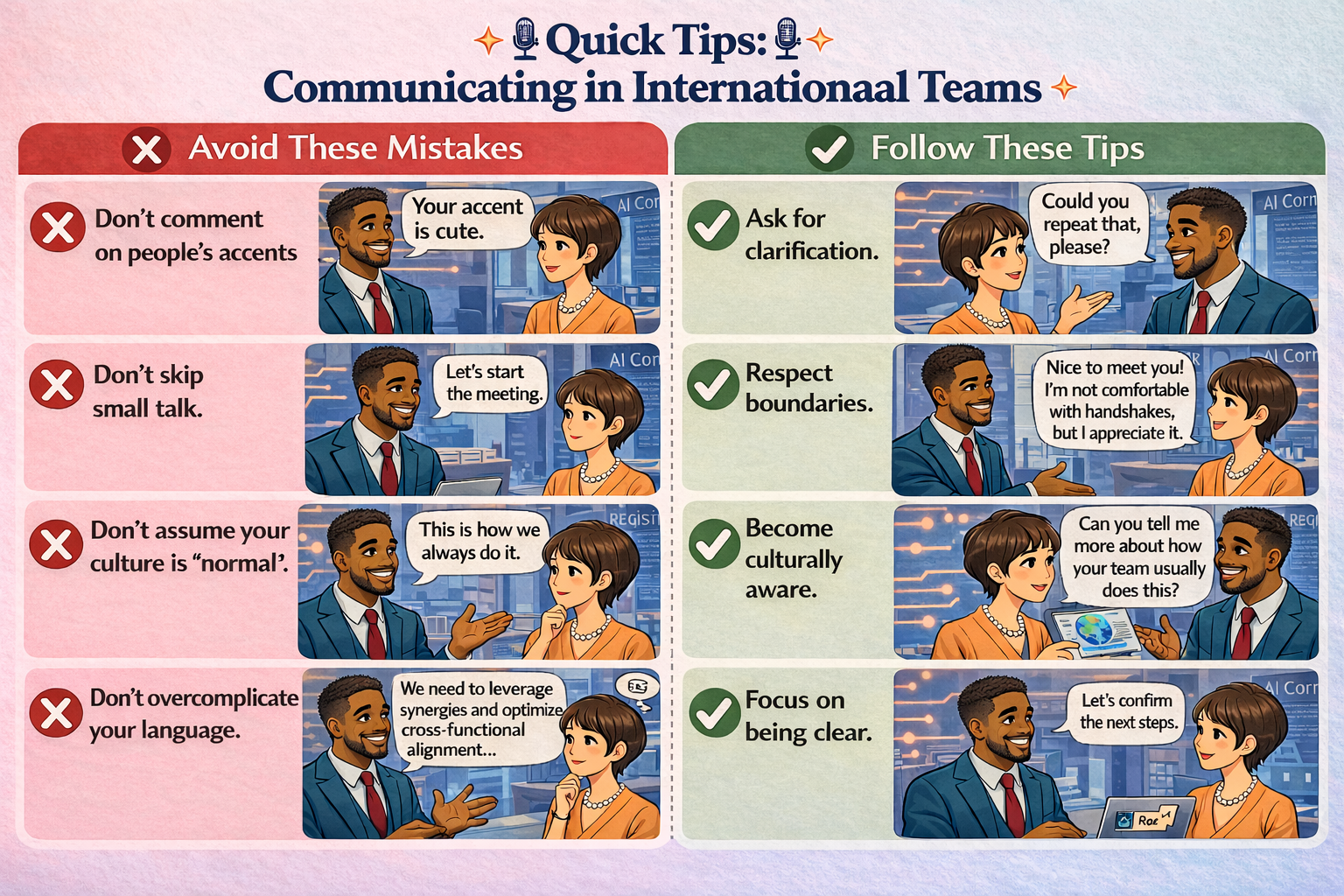
1. Ask for clarification
Don’t guess when you don’t understand something. Asking questions like “Could you repeat that?” or “Can you clarify?” helps avoid mistakes and shows professionalism.
2. Respect boundaries
Not everyone communicates or interacts the same way. Be mindful of personal space, communication styles, and comfort levels. Respecting boundaries builds trust and strong professional relationships.
3. Become culturally aware
Take time to learn how different cultures communicate. Some are more direct, while others are more indirect. Understanding these differences helps you avoid misunderstandings and connect better with others.
4. Focus on being clear
You don’t need complex vocabulary to sound professional. Simple, clear language is more effective. Focus on getting your message across, not sounding impressive.
💡 Remember: Good communication isn’t about being perfect—it’s about being clear, respectful, and willing to adapt.
📚 Resources & Tools
🎙️Podcast Episode 46: Avoid Awkward Greetings Across Cultures
🚀Join the Conversation Club
Join for just $99/month and get weekly conversation practice with frankie and other students to build the English speaking confidence and fluency that you need.
Book a FREE consultation to learn more
📱 Connect with Frankie
🍑 Peach Teach English Services
🚀 Want to Reach B2 English Faster?
This episode is part of my B1 to B2 English Fluency Series. Each episode helps you expand your vocabulary, improve comprehension, and speak with more confidence.
👉Check out the full FREE B2 Study Guide
🚀Upgrade to the B2 English Online Course
For just $5/month, you can get access to the B1 to B2 interactive course with reading, listening, speaking, and writing activities—designed to help you reach B2 English fluency faster.
Book a FREE consultation to learn more


