How to Speak English Fluently and Confidently | B2 English Listening
Speak English Without Fear and Become a Confident Speaker
Welcome back to the Peach Teach English Podcast!
Do you ever know what you want to say in English but stay quiet because you’re afraid of making a mistake? Worrying about grammar, pronunciation, or what others might think can make it difficult to use the English you already know. Building confidence starts with permitting yourself to speak, even when your words aren’t perfect.
In this episode, I’m joined by Josephine Noble, an English teacher who helps professionals feel more comfortable communicating in English. We share our own experiences with speaking anxiety and discuss how to overcome fear, let go of perfectionism, and build confidence through small, manageable steps. You’ll also get B1–B2 English listening practice through a real conversation about learning to trust yourself and communicate more freely.
Subscribe to Get Weekly Podcast Updates
Listen to the Peach Teach English Podcast
📝Episode 55 Transcript:
00:00 – Why Are You Afraid to Speak English?
Frankie: I've worked with thousands of English learners, and so many of them have one thing in common: they're afraid to speak English. They're afraid of making mistakes. They're afraid of sounding unintelligent. They're afraid they'll say something wrong and feel embarrassed.
Of course, improving your grammar and building your vocabulary are important, but sometimes what holds you back isn't how much English you know. It's the fear of actually using it.
Today I'm joined by fellow ESL teacher Josephine Noble to talk about how you can overcome that fear, let go of perfectionism, and start speaking English more confidently, even when you make mistakes.
00:45 – Meet Jo: Helping Professionals Speak English Confidently
Frankie: So Jo, could you go ahead and introduce yourself and tell us a little bit about your own experience with language learning?
Jo: My name's Jo and I'm English, and I run Jo Lingo courses in Brighton for executives who can speak good English and don't enjoy speaking English.
I think that speaks for a lot of our learners. You can do it, but it feels difficult, and maybe you freeze and maybe you have a level of anxiety, and I help people to get through that and to let it go and to actually enjoy the language that they have to speak.
01:23 – Jo’s Experience Learning French and Spanish
Frankie: And Jo, have you learned a foreign language yourself?
Jo: Yeah. I've lived and worked abroad quite a lot. I've had to learn some basic levels of languages. I lived in Japan. I've lived in Russia. When I was at school, I learned French. I also learned it from going to university and from working in France. So my French is good.
My Spanish, I learned it much later in life. In my 40s, I went to Guatemala to study in a language school to learn Spanish. The comparison between the two languages is huge. Because I started learning French when I was 11, and because my French is better, I don't have that anxiety. Maybe I make mistakes, but as a child I wasn't so bothered by making mistakes.
As an adult learning a language, my Spanish freezes quite a lot, and my brain is older, so I lose vocabulary, and I get stuck on grammar. I definitely have the fear and the anxiety in Spanish, but not in French, which is maybe an age thing.
02:34 – What Speaking Anxiety Feels Like
Frankie: Let's talk about a little bit more that fear you've experienced in your own foreign language learning. What has that looked like for you?
Jo: When I'm speaking Spanish, I can feel in my body; I tense up and I feel a level of panic. And sometimes it feels like almost I've got cotton wool in my head, and the words aren't coming out. And then as I relax, it starts working more, and I can speak, and I can communicate in Spanish.
I make a lot of mistakes all the time, but a lot of it is to do with just making myself physically relax, take some deep breaths, and try to not concentrate on speaking Spanish, try to concentrate on the message I'm trying to communicate.
03:29 – Frankie’s Experience with the Fear of Speaking Spanish
Frankie: I started learning Spanish when I was 18 years old. I also studied French in high school, but I didn't learn it so well from my high school studies.
I have gone back and studied French since, but I would say my level's probably only A2, maybe B1. So definitely not confident in my French abilities, but I will try to communicate when I need to.
And my experience with Spanish, which was my first foreign language that I learned, I did study it at university, so I was getting a very formal education of Spanish, and a lot of the grammar, vocabulary, really good guidance.
And I think I was learning it well. And I think it's important to understand how to speak it well, but it did also hold me back a lot in the process because I was always overthinking every sentence, every pronunciation. Many times I would choose, "Well, maybe it's better I don't speak up in this situation because I can't do it well or easily."
I was worried: what will they think of me? Will they laugh at me? Will I look unintelligent if I don't know how to use it correctly? It took a while for me to overcome those fears. I think what really helped me overcome them was just having to do it in some situations. I had made some friends that only spoke Spanish, and so I had two options.
Try to communicate with mistakes, or we can't communicate. And I started doing that more, and it did really help me a lot. But I've been living in Colombia for almost nine years now, and I can still face those fears today. They don't go away completely. The difference is when those fears come, you have to make a choice.
Do you let those fears keep you silent, or do you face them so that you can communicate effectively? But I do think there are some strategies that we can use to help us say yes when we have those fears. I don't think it's possible for those fears to go away completely. It's just what you do with them.
06:00 – Why Perfectionism Can Hold You Back
Frankie: Before we look at those strategies, Jo, I'm curious, what fears and insecurities have you noticed from your students?
Jo: In my work, I deal with a lot of high-level executives. They've got to where they are in their jobs because they're very intelligent and they are detail-oriented. So when it comes to learning a language, and you know the grammar and you know what is correct and what is incorrect, then they are fixated on the correctness and the perfection.
And in their jobs, that has always helped them. But it doesn't help them in language learning because ultimately what you are needing and wanting to do is to convey a message and to be clear and to be understood, especially in international business English. There are so many different kinds of English.
People make what we might call a grammar mistake in a textbook, and nobody notices the grammar mistake because they've understood the message. One of the big fears is people high up in their careers they're worried about people thinking that they are not intelligent because they have made an incorrect or imperfect sentence.
Whereas the focus needs to shift onto being clear and being confident because ultimately understanding has to be the main goal.
Frankie: I noticed that with my students as well. Perfectionism can be a big hindrance to fluency. I often like to say when learning a language, there's the accuracy element, but there's also the fluency element there.
And if you're always so focused on doing everything perfectly, it can really affect your fluency. I think perfectionism creates more insecurity in how you speak. And like you mentioned, it's a myth that when you're learning a language and you make a mistake, that somehow makes you unintelligent.
08:12 – Native Speakers Don’t Speak Perfectly Either
Jo: Yeah. I think my English is pretty fluent. It's my native language, and I'm an English teacher. I have been doing some posts on LinkedIn, and when you put a video on LinkedIn, it offers you subtitles, and you can correct yourself. And when I've been doing that, I've seen how unfluently, as a native speaker, I speak.
I'm always starting a sentence with one grammatical aim and then flipping over and ending the sentence differently. You start and stop. You change from singular to plural. That's how we speak as native speakers. We're always chopping and changing. So even a fluent speaker begins a sentence in one way and finishes in another.
And when I've been doing my subtitles on LinkedIn, it's really highlighted how un-fluent a fluent speaker is.
Frankie: And I've noticed that too with these podcasts. I'll go back and edit the transcript for the subtitles, and yeah, I've made some grammatical errors. I'm careful to correct them because I want the transcript to match what I'm saying. What you guys are going to hear when you're watching this now.
There might be some errors in the transcript because that's another myth students believe: that native speakers speak perfectly, and we don't. We make a lot of errors when we speak. Now if you're writing an academic paper, that's when you really have to get all of those grammar mistakes fixed. But when we're speaking, it's in the moment. We're trying to form all the ideas at the same time.
One of the other insecurities is that non-native English speakers feel like they need to speak like a native speaker, but even their concept of a native speaker is unrealistic. We will make mistakes, and you will make mistakes too, and that's completely okay.
Jo: I challenge some of my learners to do the same thing in their native language, to record a video of themselves, look at the transcript, and see how perfect they are in their native language, and then bring their expectations to be more realistic when they're speaking English.
Frankie: Ooh, and you've done that activity with them?
Jo: I have, and everybody's horrified because I was horrified when I did it with myself. It's a big surprise to see how unfluent we all are.
Frankie: We're definitely not 100% accurate all the time, so I think giving yourself that grace is important. I do think unfortunately people give more grace to native speakers with their mistakes.
I think it's 'cause we speak more in the natural rhythm, so they're not as obvious. But that's where that confidence factor comes in. When you are more confident in your ability to communicate, it doesn't become so obvious every little mistake that you're making because that's not what the conversation is focused on.
11:17 – Get the Transcript and Study Guide
Frankie: We're gonna get back into the conversation, but first I just want to let you know that this episode comes with a full transcript and study guide to help you improve your English. So if you'd like to check that out, you can click the link in the description or scan this QR code here on the screen.
11:37 – Myths About Speaking Perfect English
Frankie: Let's get back to the conversation here, Jo.
Do you know of any other myths or lies that English learners tend to believe that are just not true?
Jo: Well, there's the myth about perfection being the ultimate goal. People choose perfection to be the ultimate goal, whereas really being clear and confident is what a better goal would be.
And that mistakes can make you look unintelligent, whereas people would be more likely to judge you if you hesitate or if you keep on self-correcting or editing yourself than if you just delivered a sentence that's a little bit imperfect, but with confidence and clarity.
12:24 – What If You Don’t Understand or Aren’t Understood?
Frankie: Yes, I think those are big myths people believe too. I think another insecurity, Jo, and totally valid, I can feel this too in my own experiences, is the fear that you're not gonna understand what the other person says to you, and vice versa.
What if they don't understand me? What if it comes out as word vomit? What if my pronunciation isn't clear? Maybe they're not necessarily worried about being perfect, but like you said, they do want to be clear and understood. And I think that can be a real insecurity for learners. Do you have any tips to help them with that?
Jo: Well, going back to the fear of not being understood, I just wanted to mention that I always tell my students if they don't understand, to say no instead of saying yes.
Normally, if you don't understand and you're wanting to be polite and not look stupid, you'll go, "Yes." But you can get yourself into trouble by saying yes too much. Also, I find this difficult myself, but you have to be brave enough to say, "I don't understand."
And it's really embarrassing to say it on repeat, but if you pretend at the end that you do understand, it's not gonna help you. And sometimes the situation just doesn't end well, and that's life. It is really key to not pretend you understand, because the only way to improve is to understand. If you keep going pretending you understand, then you're not improving, and you're lying to yourself and the other person.
Frankie: As uncomfortable as it might be, we do have to humble ourselves and say, "Hey, I need a little help." I think one of the reasons we feel so insecure about that is it goes back to what you were saying, Jo: we feel like we're unintelligent because we didn't understand.
And you know that you're intelligent enough to understand these things in your native language. So it has nothing to do with your intelligence. It has everything to do with your fluency in the language. And the only way to become more fluent is to do it more and look for the things you don't know. If you only focus on the things you know, you're not getting better.
So every time you don't understand something, or you're confused by something, that's actually a sign that you're learning something new and you're improving. So don't look at it from the negative side. Look at it as the positive side. With every mistake, every uncomfortable situation, I got better today.
Jo: It's a massive learning opportunity, isn't it? Huge learning opportunity.
Frankie: Exactly. I totally agree, Jo.
15:34 – Build Your Confidence One Step at a Time
Frankie: What's really important for us when we're learning English or another language is to not focus so much on every little detail, and like you're saying, focus on that communication, right?
So my question for you, Jo, is what can students do to focus more on enjoying the process instead of worrying about every little mistake?
Jo: Really, what we're both discussing here is what's happening in the brain while we're trying to learn and use a foreign language. And the fear and the anxiety we're talking about is because when you're under stress, your brain is treating this like it's a threat, that something bad is happening to you, like you're in danger.
And then your response can be to freeze or to not say anything because maybe it's safe. And then the more you don't say anything, your brain is teaching you that's safe, you're still alive, everything's okay. So actually what you need to do to help yourself is to start to rewire your brain and to teach it that the situations that you're in, you can get through and you can survive.
So there are lots of different activities you can do that will start to teach you this is okay, I can do this, I survived this, and I can rock this as a language learner. And it's kind of like exposure therapy. The more you do something, and you get through it, and you survive, the more you feel okay with it.
I used to be scared of the dark, and I started forcing myself to walk distances in the dark, and now I'm not scared at all. This is when I was a child, but it's the same idea with language learning.
The idea is you do repeated exercises, and you can say it's like a confidence ladder. So level one is really, it's not a dangerous situation, it's very safe, everything is okay, and you practice in that situation.
So you could leave yourself a voice note. Who is judging you? You may feel silly, but nobody is judging you when you leave yourself a voice note. So that could be level one, and you do that for a while.
Take it to the next step on the ladder. You can leave a voice note for a friend, a teacher. They're not judging you; they're your teachers, but it's a little bit more scary.
But when you manage to do that, you've taken it to the next level. Then you could be in a WhatsApp group, and you leave a voice message for a few people. You take it up step by step by step, and the more you do that, the more you feel like you've survived and you're less scared, and it takes away the fear.
So, but you have to work to do that rewiring. The only person who can make this happen is you, and it's not easy.
18:36 – Building Confidence Through Repeated Practice
Frankie: For sure. And maybe that final level goal could be be a guest on a podcast in English, or give a presentation in English.
Jo: Yeah.
Frankie: And maybe that seems really far in the distance right now if you're really struggling with that confidence, but that's exactly what Jo is saying. Take those little steps and watch yourself grow.
For example, I used to hate being on camera. I used to hate hearing my own voice. When I first started making videos or this podcast, I was really uncomfortable watching myself as I was editing, hearing my voice. Now, I don't even think about it. It's just me there on the camera.
I'm editing myself because I've done it so many times that it doesn't seem so strange anymore. I'm definitely more confident on camera now, but that didn't happen naturally. It happened because I showed up again and again. I faced the fear again and again. And that doesn't mean I'll never feel uncomfortable on camera again.
There will be moments where I have to say, "I'm a little uncomfortable today, but I signed up for this, and I'm gonna do it." I think that's the same with any kind of fear, something we're trying to build confidence with. When you start to get that feeling, you can fight or flight. My advice for you today is to start choosing that fight, and it will get easier over time.
You'll actually start to realize nothing really happens if I make a mistake. If you do make a mistake, you can laugh at yourself about it. It's not the end of the world.
This happens to me sometimes here in Colombia. I go somewhere like to the grocery store, the bank, the doctor, and I'm a little nervous because people usually comment on my accent.
"You're not from here," they always say. And that always makes me a little insecure. But at the same time, why? I'm not from here, and that's not a problem. And if they think that's a problem, that's their problem. Because I am here communicating, and I actually believe in my ability to communicate.
Will I have a Colombian accent? Probably not. Am I going to make some mistakes? Maybe. But I know that I have the knowledge and the ability to do it. And then if something is hard, I can find a solution to eventually get to my goal. That really is the key: focusing on effective communication, not perfect communication.
Jo: I really agree with you there.
21:41 – Take a Breath, Relax, and Slow Down
Frankie: If you could leave one final tip with our audience to help them become more confident in their English, what would you share?
Jo: One last final tip. Taking a breath and trying to physically relax. That's huge. We haven't talked about alcohol, have we? And I don't wanna talk about alcohol, but that's the thing.
People say that, "Oh, isn't it funny that after one alcoholic drink I can speak the language better?" And I'm not advocating drinking alcohol, and I never tell my students to drink it. But the thing is, alcohol relaxes your body, and that's why you can speak better. Your brain has not got more intelligent.
You have physically relaxed, and you're less focused on being perfect. So if you manage to make your body relax by taking some deep breaths or going through some relaxation exercises, you will speak better. That's an important technique. People often forget about breathing.
Frankie: Oh, yeah. For sure. They feel so much pressure 'cause when we're under stress, our body gets hot and sweaty, clammy.
We tense up, and that probably is that start of that fight-or-flight response. But like you're saying, try to calm it where it doesn't even become a fight-or-flight response anymore. It's just a, "I can do this."
Jo: Yeah. Or, "I'm gonna try to do this."
Frankie: Exactly. Yeah.
Jo: Some people's response to stress is to speak more quickly, and slowing down and taking a deep breath can make it all feel a lot easier.
Frankie: And nobody needs to speak super fast. And again, at the end of the day, it's all about communication and clarity, so go with the flow.
23:32 – Connect with Jo
Frankie: 100%. I agree. Well, thank you so much for joining me today. Jo, if our audience would like to contact you, how could they do that?
Jo: They could go to my website, which is www.jolingo.co.uk, and I'm also on Instagram.
And I run one-to-one in-person courses in Brighton, UK, for executives who need help with their English to feel less blocked and less anxiety and to feel confident and embrace all of the business English opportunities they have in their lives instead of avoiding them, and I can make it all more fun for them.
Frankie: That sounds awesome. So guys, you can contact Jo, and I'll leave those details in the description for you so you can do that easily.
24:27 – Study Guide and Wrap-Up
Frankie: And also, I want to remind you that this episode comes with a full transcript and study guide, so if you'd like to check that out, you can click the link in the description or scan this QR code here on the screen.
And thank you for listening to the Peach Teach English podcast. I'm Frankie Mesmer, your host, and this space is dedicated to taking B1 students to B2 English fluency and beyond.
If you liked this episode, be sure to like it, hit that subscribe button, and I'll see you in the next episode. Bye, everyone.
👣 Steps to Become a Confident English Speaker
Try these tips from the episode to overcome your fear of speaking English and feel more confident using what you know.
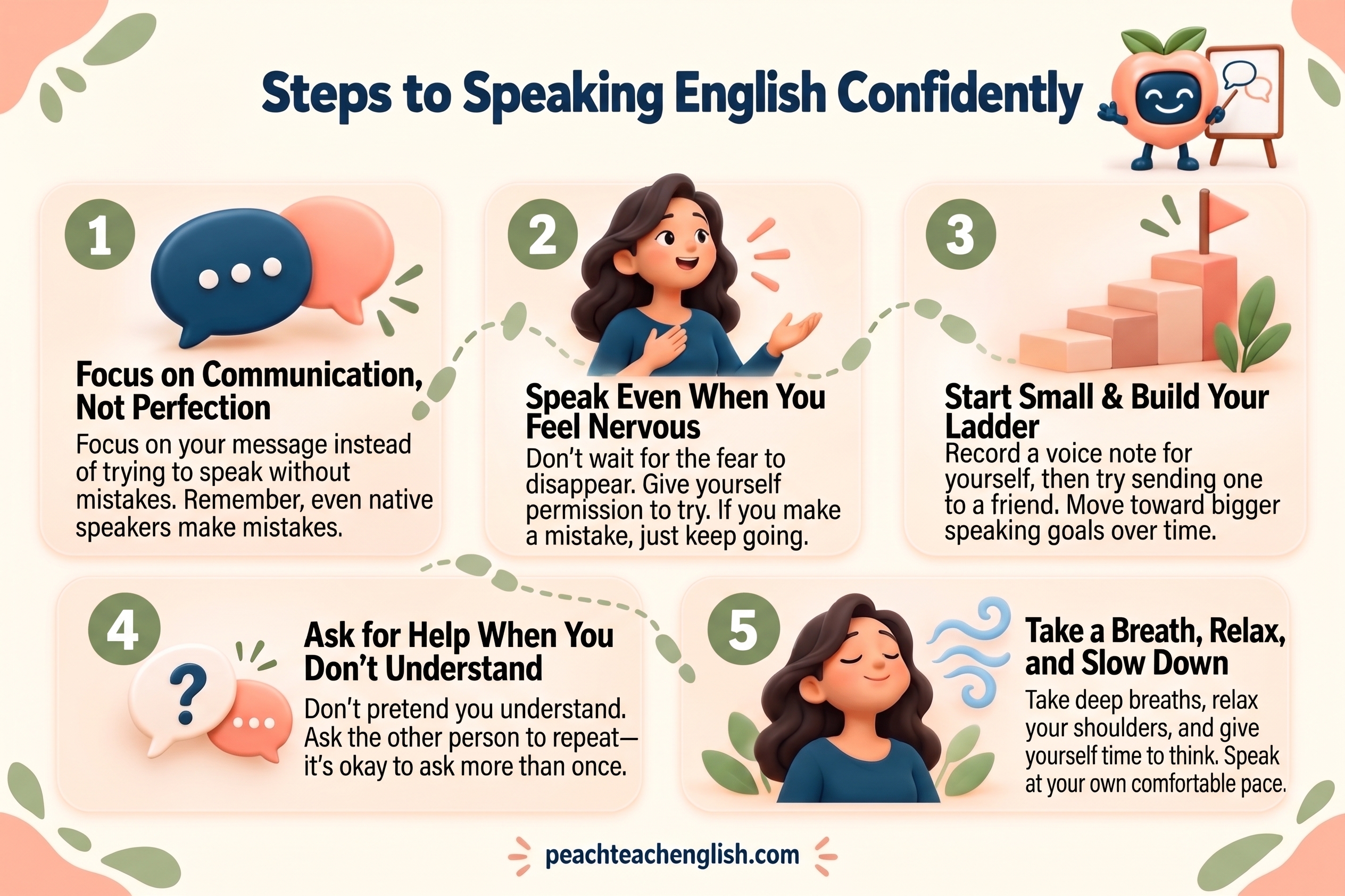
Step 1: Focus on Communication, Not Perfection
Focus on the message you want the other person to understand instead of trying to speak without mistakes. Remember that there is no such thing as perfect English. Native speakers also repeat words, change direction, and make mistakes.
If you're not convinced, try Jo’s activity: record yourself speaking in your native language and then go back and listen to it and read the transcript. Notice how imperfectly you actually speak. Then ask yourself whether your expectations for your English are realistic.
Step 2: Speak Even When You Feel Nervous
You don’t have to wait for the fear to disappear before you speak. When you feel nervous, give yourself permission to try anyway. Trust your ability to communicate and find a solution if something is difficult. If you make a mistake, you can acknowledge it or even laugh about it. Don't let it stop you; keep going. Each time you participate, you give yourself another chance to learn something new and build confidence.
Step 3: Start Small and Build Your Confidence Ladder
Start with a speaking activity that feels manageable, such as recording a voice note for yourself. Next, try sending a voice note to a supportive friend or teacher. Then, move up by responding with audio messages in a WhatsApp group. Over time, you can work toward a bigger goal, such as having natural conversations, giving a presentation, or being a guest on a podcast in English. Repeat each step to make it more familiar, then move up the ladder at your own pace.
Step 4: Ask for Help When You Don’t Understand
There will be moments when you're confused. Don't pretend you understood something that you didn't. Be honest and ask the person to repeat or explain, even if you need to ask more than once. Needing clarification doesn’t mean you’re unintelligent. It allows you to learn something new and understand the conversation better.
Step 5: Take a Breath, Relax, and Slow Down
When you’re about to speak and notice your body feels tense, don't force yourself to start speaking quickly. Take a few deep breaths, relax your shoulders, and give yourself time to think. It's totally ok to pause between ideas and speak at a comfortable pace. You don’t need to speak super fast to communicate well. Focus on making your message clear.
📚 Resources & Tools
📱 Connect with Jo
📱 Connect with Frankie
🍑 Peach Teach English Services
🎬 What to Watch Next
If you've ever felt like you can understand almost everything you hear in English but still struggle when it's time to speak, you're not alone. Check out this video where I break down exactly why that happens and what you can do to fix it.


