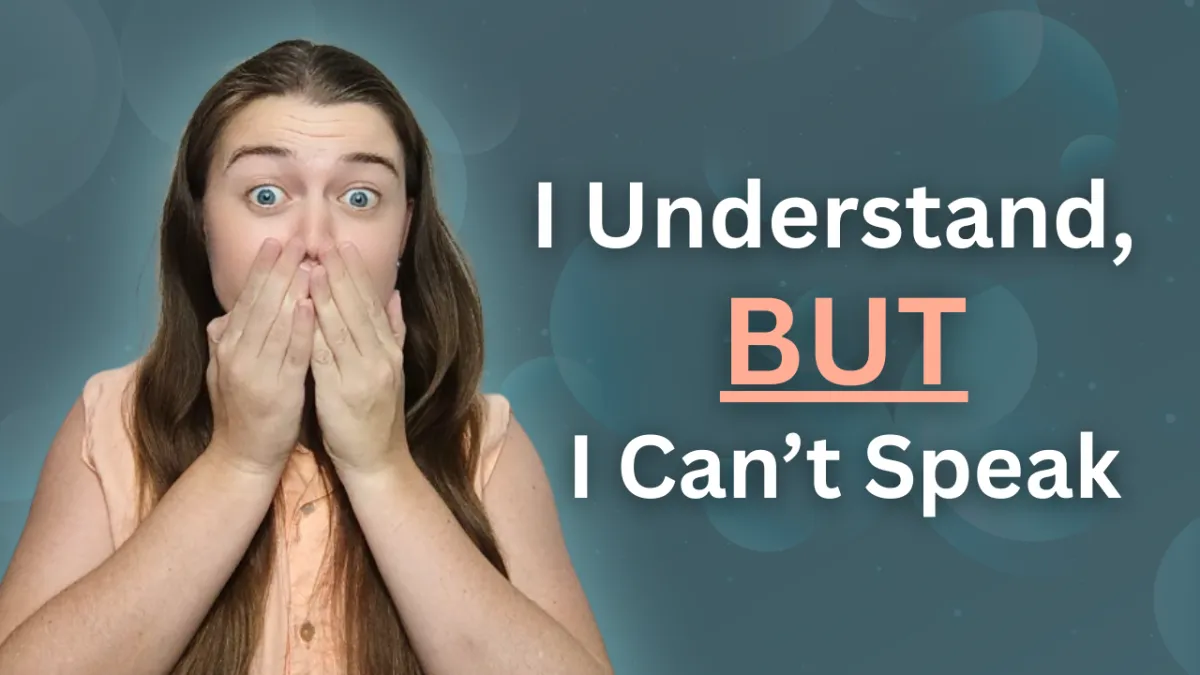
Why You Understand English but Can’t Speak
If you’ve ever thought, “Why do I understand English, but can’t speak?” you’re in the right place. You’re not failing, and it’s not that your English level is “too low.” For many B1–B2 learners, listening and reading come more easily, but speaking feels stressful, overwhelming, and sometimes even embarrassing.
In this episode of the Peach Teach English Podcast, I explain four key reasons why this gap happens, including fear, perfectionism, and lack of speaking practice. I also share personal stories from my own language-learning experience and offer practical tips to help you start speaking with more confidence.
This episode and transcript are ideal for B1–B2 English learners who want to improve their vocabulary, practice listening comprehension, and learn strategies to take their English speaking skills to the next level.
Subscribe to My Newsletter for Podcast Updates
Watch & Listen to the Peach Teach English Podcast:
📝 Episode 45 Transcript:
⏱ 00:00 – Intro: Why You Understand but Can’t Speak
If you understand English but freeze when you try to speak, this video is for you, and no, the problem is not your English level. I’ve been there when I was learning Spanish. I understood a lot, but I stayed quiet because I was afraid of my mistakes. That fear slowed my progress for years. I see the same thing in my students.
They understand everything, but when speaking feels hard, they switch to their native language. That’s not a language problem. It’s fear and perfectionism. In this video, I’ll show you why this happens and what you can do to start speaking English more confidently without beating yourself up for making mistakes.
So guys, we’re gonna look at four reasons why you understand English, but speaking it is much more challenging.
⏱ 00:58 – Reason 1: Understanding Is Easier
And number one is that it’s actually completely normal. Guys, we often understand something before we can use it or produce it. When we’re little children, right? It takes us a year listening to the language before we’re able to speak and produce the language for the first time.
So if you find that your listening and reading skills are much better than your speaking and writing skills, don’t feel bad about it. It’s normal because first we need to receive the information. We need to either hear the language or read the language to be able to know that this language exists.
And secondly comes the producing of that language, which is speaking and writing. So the first step is understanding. The second step is producing and using it, and that is what is required in speaking. So be patient with yourself. You don’t actually have a huge problem.
⏱ 02:18 – Reason 2: Fear and Perfectionism
Reason number two, fear is what keeps you silent. You actually might have more speaking ability than you give yourself credit for, but you’re having a mental block, and these could be things like embarrassment. Perhaps you’re embarrassed that someone might notice your accent or your grammatical mistakes, and so perfectionism can actually really hold you back from developing your speaking abilities, and it’s actually completely normal to do this.
I think most people that try to learn their first foreign language are really trying to get every little thing right. And of course we don’t want to make a bunch of mistakes, but remember, making mistakes are part of the process. And actually, the people who learn to speak faster are the ones who make more mistakes early on in their learning journey.
Your fear of making mistakes is actually slowing your English speaking progress.
⏱ 03:35 – Personal Story: How I Embraced Discomfort
Your fear of making mistakes is actually slowing your English speaking progress. Let me explain with a story. So when I was 18 years old, I started learning Spanish at my university, and I actually loved learning the language, and I was very good in my class. I probably was number one in my class most of the time, so I got a lot of the grammar and vocabulary very fast, but I often remained silent because if I was unsure that I could pronounce it correctly, or if I was going to use the grammar correctly, or if I didn’t have the perfect word, it was better just to stay silent. And that really slowed my progress for years.
And what really changed everything for me is when I made friends with a sweet woman from Honduras, and we would hang out, and I had to speak completely in Spanish because her English level was pretty much non-existent. And I remember one day she invited me to her house to help her update some information on her Facebook page.
Now, I didn’t spend a lot of time on Facebook in Spanish, and I had never really helped someone with these more technical vocabulary and skills. So when she was asking me to help her, I often got stuck. It was uncomfortable, but she didn’t speak English, so I couldn’t just fall back on my native language.
I had to sit in that discomfort and take on the challenge, and even though it was difficult, I was actually amazed at how much I was able to communicate. Was it perfect? Oh no. But in that moment, I really realized what I was capable of, and so I started challenging myself to face those moments more and more.
Although worrying about making mistakes is normal, it is holding you back. And today I have a very advanced level in Spanish, and I’m living in Colombia, and I still feel nervous sometimes when I have to go to the doctor or in more formal situations, and I need to speak in Spanish. They will mention my accent. They’ll often tell me, “You speak Spanish very well,” but I’m also nervous and a little embarrassed by what they might think of my Spanish, but the key is I don’t remain silent. When you feel that discomfort, don’t be silent and don’t walk away from it. You must face it. You must embrace it.
That discomfort will never completely go away, but it does get easier.
⏱ 06:51 – Reason 3: Speaking is Mentally Harder
Speaking requires many things happening in the brain. You need to actually be able to pronounce the words. You need to know the words, and you need to be able to organize the words. When you read, you just simply have to understand. When you listen, you just have to understand. But with speaking, you actually have to create it, and this takes a little more brain power.
You might need a little more time to actually be able to construct your idea, and this can be really tricky when you don’t remember the words that you need. Oftentimes, when you’re just listening or reading, you can just understand through the context or go, “Yeah, I’ve seen that word before,” but when we’re speaking, you actually need to pull it out of your brain and say it.
And many students feel trapped in that moment when they can’t think of the word. Or maybe you’ve never learned the word, and that’s another problem, right, when you just need to grow your vocabulary.
⏱ 08:27 – Strategies to Improve Speaking Structures
And if you wanna learn ways to grow your vocabulary, you can check out this video. But here we’re just talking about getting stuck when you don’t have the word that you’re looking for. There are a few solutions to this, and it’s not translation.
When you are talking to someone, you can just say, “Hey, what’s the word? What’s the word for the thing you use with paper to take notes?” And they say, “Oh, that’s a notebook.” Okay. Maybe an easy example. But they go, “Oh, that’s a notebook.” And you, “Ah. Yeah, a notebook. Thank you. I can’t believe I forgot that word.”
So instead of just looking for translations or being quiet, use the language you do have to describe that thing and really try to move away from translation, because some things are cultural. They could be expressions, and they might not translate so easily.
So try to stay in the language as much as possible, and this will actually help your speaking over time, especially in terms of fluency, because when you’re switching back and forth in languages, it’s more work for your brain.
For example, when my parents come to visit me here in Colombia, I speak English with them, and I speak Spanish with my wife. And sometimes there are moments when I’m translating for them, or I’m just having a conversation here, a conversation there. And sometimes I’ll speak to my family in Spanish and my wife in English, and they just look at me. “Why are you talking to me in that language?” It’s pretty exhausting on my brain. It’s a lot of work. But if you’re staying in the same language, you’re not having to move back and forth so much.
So, really try to purely stay in the language as much as possible.
Another thing that does trip people up is the organization. Am I using the right preposition? Does the pronoun go here? Is this the right tense? It’s confusing. And sometimes it’s just the way the language is. It’s not even something easily explained logically. And it can be frustrating. And again, we have to look back on that part of being embarrassed.
Don’t try to get it perfect every time. Just speak, and hopefully they understand you, but I also think you should be trying to improve, correcting those word collocations. We say in English, “think about something,” not “think in something.” We say, “think about something.”
So studying these word collocations so that you can use the right ones will help you build the confidence to speak better. Another great strategy to help you get the structure down so that it’s not so mentally taxing on the brain is writing.
And this is what happens in school, right? When we’re little, we listen, then we speak, and then we learn grammar and how to do it correctly. Little kids make a lot of mistakes. The thing is, they don’t care. They’re just trying to learn. Communicate the best they can, and people don’t really judge them for that.
And I think that’s why, as adults, our speaking process slows down a lot because we are overthinking it. Just try and speak, let yourself make those mistakes, and then when you’re really trying to improve them, do some writing.
This is going to teach your brain. And guys, you can do texting, typing, but I really recommend getting a notebook and writing because there’s something special about the physical motion connected to the brain when you’re actually writing in the notebook and write your ideas. This is going to actually help you improve your speaking.
The only thing it’s lacking is the pronunciation, but everything else is gonna help you start to structure your sentences more correctly, be able to develop more complex ideas. So I would really recommend each week doing some writing exercises. This will really help you improve your speaking as well.
⏱ 13:14 – Reason 4: Lack of English Speaking Practice
And finally, number four, which is probably the most important, the reason your speaking skills aren’t as good as your understanding is because you’re doing a lot more listening and reading than you are speaking. You can learn a lot through self-study, especially about the theory of the language. You can build your vocabulary, learn the grammar, but when you do self-study, you’re missing some valuable pieces.
And the most important one is speaking practice. So when you practice with a tutor, a friend, a language partner, maybe AI, you’re actually getting some speaking practice, but it’s not just any speaking practice because you could be speaking incorrectly. It’s important to get speaking practice with someone that is going to give you corrections to help you grow your vocabulary, improve your pronunciation, correct your grammatical mistakes.
So I’m not saying stop reading and listening. I’m a big believer in all four language skills, and my favorite study plan is practicing reading, listening, speaking, and writing every week. But if you’re asking yourself, “Why can I understand, but I can’t speak,” and you’re not practicing speaking, ding, ding, ding, ding, ding.
That is the primary issue, and you need to find a solution as soon as possible because we learn a language to communicate. This is actually what makes learning the language more enjoyable when we’re actually able to use it to communicate with real people, and that’s why I’m hesitant to say AI. I think you can practice with AI, and it’s actually a great tool to add into your language studies, but it’s not as effective as speaking with a real person because that’s the purpose of learning the language in the first place, is to communicate with real people, not with a robot.
So if you’re wondering what ways you can practice speaking, my top tips are you can find some language partners using Tandem or HelloTalk. My advice is message some people, try to find the ones that are more serious, actually about learning the language, not finding a boyfriend or girlfriend, but they do exist on those apps. I’ve used them for Portuguese, French, and Turkish, so you can be successful on there. And you can message them every day on WhatsApp or right there on those apps.
And if you find the right people, they might even hop on a video call with you, and you can actually become friends and practice English. The key is ask for corrections. If you’re not getting corrections, you might not be improving your speaking as much as you think, and that’s why having a tutor really is the best option, because we are trained to explain the language to you, and we will give you regular corrections in every lesson.
And if your tutor or teacher is not giving you those corrections, I would say your class is not as effective as it could be. So, want corrections. Stop trying to be a perfectionist. Don’t be embarrassed by your mistakes. Know that with every mistake, you’ve learned something new, and that makes you better at English today.
And if you would like support from an English tutor, you are welcome to sign up for my conversation classes. I offer them in group and one-on-one. And if you’d be interested in practicing your English speaking with me, you can go to peachteachenglish.com and schedule a free consultation. And there we’ll get to know each other, identify your level and goals, and see which plan is the best for you to start speaking English more fluently as soon as possible.
⏱ 18:17 – Final Motivational Message
And that wraps up the four reasons. If there's one thing I want you to remember from this episode, it's this: discomfort is normal, and it will never completely go away, but it does get easier. The key is to embrace it because that's when you'll truly become more confident in your English speaking skills.
Speaking confidence doesn't come from perfection and knowing all the rules and vocabulary. It comes from regular supported practice. So if speaking English is important to you, make it a weekly part of your routine. Schedule it in your calendar, and I'm here to help you with that if you're interested.
Thank you so much for listening to the Peach Teach English podcast. I'm Frankie Mesmer, your host, and this space is dedicated to helping you go from B1 level English to B2 English and beyond. If you found this episode helpful, be sure to like this video and subscribe so you can keep watching content that helps you build real English fluency.
I'll see you in the next one.
🔁 Improve Your Speaking Study Guide
Understanding English is a great achievement — but speaking requires different practice. This study guide will help you move from understanding to confidently speaking by focusing on what actually improves fluency.
✅ Weekly Speaking Actions:
1️⃣ Speak Before You Feel Ready
When it's your turn to speak, do it even when:
Your sentence feels simple
You’re unsure about grammar
You don’t have the “perfect” word
Action: Choose one weekly situation (small talk, class, meetings, messages) and say something instead of staying silent.
2️⃣ Stay in English Instead of Translating
Forgetting words is normal, but silence and switching languages slow progress.
Action: Practice using these phrases instead of translating:
“What’s the word for…?”
“It’s something you use to…”
“It’s similar to…”
Your goal is to keep speaking, not to be perfect.
3️⃣ Write Once Per Week to Build Confidence With English Structures
Writing helps your brain organize ideas, so speaking feels easier over time.
Action: Once a week, write for 10–15 minutes:
Don’t try to be perfect on the first draft
Use a tutor or AI to help you correct mistakes
Practice structures and vocabulary you find challenging
4️⃣ Get Speaking Practice With Feedback
Speaking improves fastest when someone corrects you.
Action: This week, practice speaking with someone and be sure to:
Ask for corrections in structure, pronunciation, and word choice
Stay engaged and curious about your conversation partner
Practice at least once per week to stay consistent
🔁 Final Reflection
If your understanding is much stronger than your speaking, speaking needs to become a regular part of your English fluency plan.
Ask yourself:
How many days per week can I realistically practice speaking?
If you’re busy, one day per week is enough to see real progress. The more often you speak, the faster your confidence and fluency will grow.
Check out the resources below to help you make English speaking a weekly habit.
🔗 Resources to Help You Practice Speaking
Tandem → https://www.tandem.net
HelloTalk → https://www.hellotalk.com
🎯 Want to Practice Speaking English With Me?
English classes at Peach Teach English focus on real conversation and natural grammar, so you can speak confidently in everyday situations.
You can join group classes or 1-on-1 coaching to start improving your English fluency today.
👉 Book your FREE consultation now
🚀 Want More English Speaking Tips?
One of the biggest challenges to speaking confidently and fluently is dependence on your native language. If you often translate in your head, check out my video on how to stop translating and start thinking naturally in English.


