How to Understand Fast Spoken English: Connected Speech Patterns
Improve Your English Listening with Connected Speech
Welcome back to the Peach Teach English Podcast!
Do you ever wonder why you understand English when you read it, but struggle to understand native speakers when they talk fast? One of the biggest reasons is something called connected speech.
When we speak naturally, we don’t pronounce every word individually. We shorten words, connect sounds, and reduce others. If you're waiting around to hear every word clearly, you’ll always feel confused and frustrated.
In this episode, I explain the most common connected speech patterns with examples, share ways to practice your listening, and guide you through a shadowing activity so you can start training your ear.
This episode and transcript are ideal for B1-B2 learners who want to improve their listening comprehension and understand fast-spoken English more easily.
Subscribe to Get Weekly Podcast Updates
Listen to the Peach Teach English Podcast
📝Episode 30 Transcript:
⏱ 00:00 – Introduction: Understanding Fast-Spoken English
Welcome back to the Peach Teach English podcast. I'm Frankie Mesmer, your host, and today we're going to look at reasons why it's so difficult for you to understand fast-spoken English. And after this episode, you will be able to understand native speakers better.
Have you ever been listening to native speakers, maybe in a podcast or a movie, and they're speaking really fast? You can pick up a couple words, perhaps “phone,” “weekend,” but all those other words, they just seem to kind of run together, and it can feel really difficult to catch everything that they're saying.
Well, there's a complete explanation for that, and that's what we're going to look at today. Of course, improving your vocabulary, understanding grammar structures will help you improve your listening comprehension. But listen carefully: what I'm gonna share with you today is going to show you exactly what native speakers are doing when we speak fast so that you can start to understand more easily.
⏱ 01:09 – Why Fast English Is Hard to Understand
Why is it so hard to understand native speakers or fast English? Well, one of the main reasons is when you're studying English in a textbook, you're memorizing vocabulary. You are seeing English and hearing English in a very literal way, pronounced slowly, very clearly. But in reality, that's not how native speakers talk at all. We actually cut some of the sounds off, or we run the sounds together.
So you're expecting to hear a word the way that you learned it, like, “What are you doing?” But in reality, we're going to say it: “Wutterudoin? Wutterudoin?” And if you're waiting to hear every single word clearly, you're gonna be confused. You're not going to catch it.
So, it's important to learn exactly what we are doing to get these sounds out faster. We're going to look at three of these reasons.
Number one: contractions.
Number two: connected speech.
And number three: the emphasis of important words.
So this is why sometimes when you read the subtitles, you can understand it 'cause you see it, but we're actually pronouncing it a bit different than you expect because spoken English can be very different from how it's written. So let's go ahead and get started on those tricks.
⏱ 02:57 – Contractions: The First Key to Fast English
So the first one is contractions. Now, you're probably very familiar with a lot of the common ones, like:
“I am” = “I'm”
Or:
“I would like” = “I'd like”
But there are some even trickier contractions that we say really fast. And if you're not familiar with these, you probably are not catching what we are saying at all.
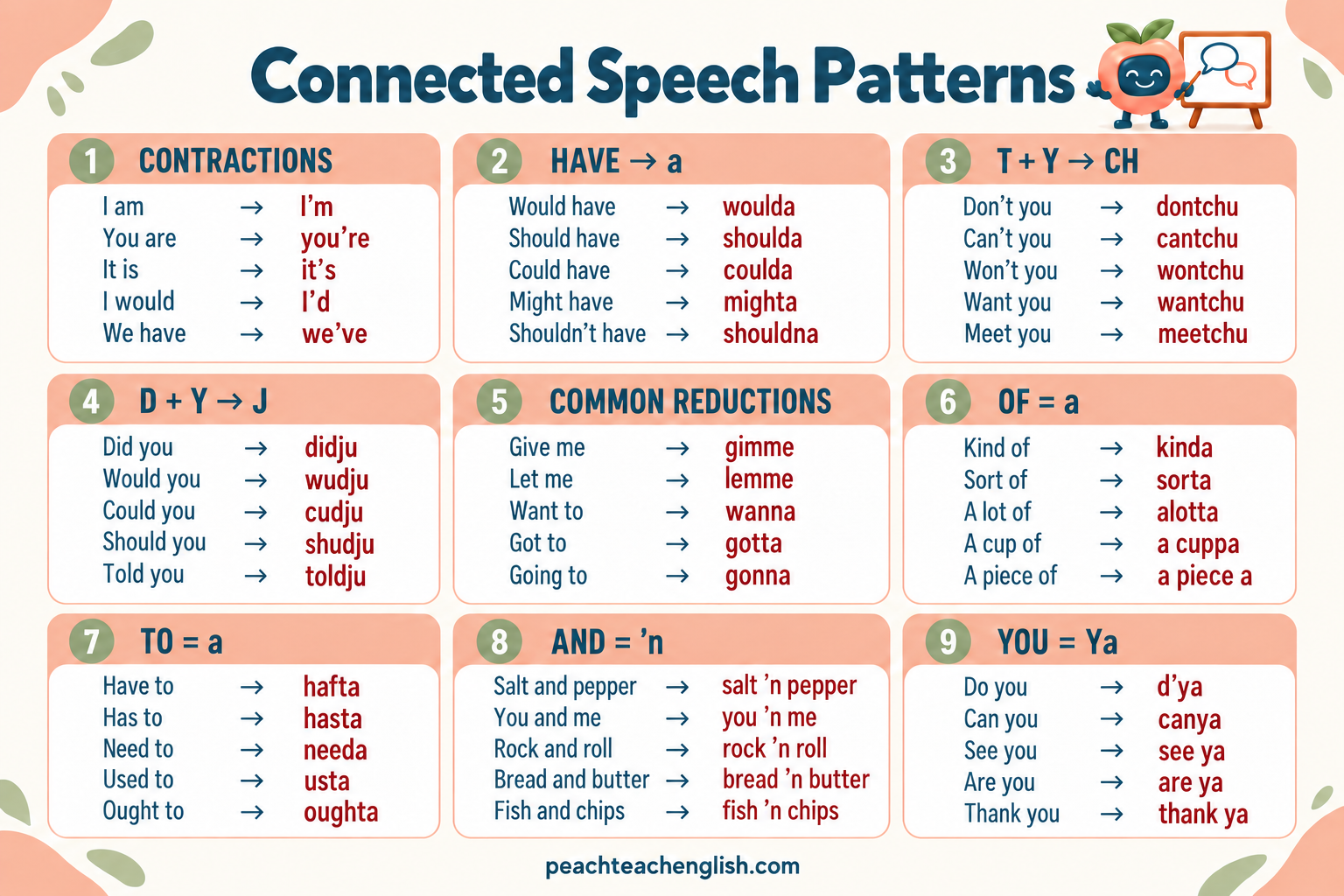
The most confusing contractions actually are the ones that have the word “have” because we kind of just don't really pronounce “have” at all. We just kind of add an “uh.”
So I'm going to show you 10 common examples of these contractions, and I'm gonna do it slowly. So try to repeat after me so you can also practice your pronunciation.
So the first one is:
1. Would have
But we say “woulda.”
“I would have told you.”
“I woulda toldja.”
2. Should have
“Shoulda.”
“You should have called me.”
“You shoulda called me.”
3. Could have
“Coulda.”
“He could have helped you.”
“He coulda helpju.”
4. Might have
“Mighta.”
“She might have left.”
“She mighta left.”
5. Must have
“Musta.”
“He must have known.”
“He musta known.”
6. Would have been
“Woulda been.”
“It would have been better.”
“It woulda been better.”
7. I'd have
“Ida” is a good one.
“Ida.”
“I'd have told him.”
“Ida told 'em.”
“Ida told 'em.”
8. Shouldn't have
“Shouldna.”
“You shouldn't have done that.”
“You shouldna done that.”
9. Wouldn't have
“Wouldna.”
“He wouldn't have known.”
“He wouldna known.”
So, as you can see, we are reducing a lot of these sounds and putting them together, and if you're not familiar with them, it's really hard to hear it.
So I really recommend repeating this. You can also practice pronouncing it yourself and train your ear to understand these reductions within these contractions.
⏱ 05:35 – Connected Speech: Merging Sounds Together
So now let's look at number two, which is connected speech. You see, we don't pronounce words in isolation. We pronounce them together in a rhythm. So sometimes those sounds will come together, and sometimes they might even change completely. So let's look at some examples of this.
The first one is when there's a T and a Y, it becomes a CH sound.
For example:
“What are you doing?” = “Whatchu doin?”
“What did you say?” = “Whatchu say?”
“Don't you know?” = “Dontchu know?”
“Can't you see?” = “Cantchu see?”
So maybe you noticed here, we don't say the T and E. We say the CH. “Cantchu see?” So repeat this section. Try to pronounce after me and train that ear some more.
Another one is when we have a D and a Y; it makes a J sound, like the J, a J sound.
Here are some examples:
“Did you go?” = “Didju go?”
“Would you like some?” = “Wudju like some?”
“Could you help me?” = “Cudju help me?”
“Did you get your keys?” = “Didja get your keys?”
So as you can see, we're taking that D and that “ye” and making a J sound.
“Didja, didja.”
So again, repeat this section, try to pronounce after me, and keep training that ear.
Just to add some fun ones. These are probably some of the most common ones you will hear.
For example:
“Give me that.” = “Gimme dat.”
“Let me see.” = “Lemme see.”
“I want to go.” = “I wanna go.”
“I've got to leave.” = “I gotta leave.”
These aren't just slang. It's actually a way that we are merging or reducing sounds so that we can keep the rhythm and speak much faster. So continue practicing all of these reduced sounds or merging sounds so that you can sound more like a native speaker and, most importantly, improve that listening comprehension.
⏱ 08:17 – Emphasis and Reduction: The Rhythm of English
And finally, part three. So when we have a sentence, there are some words that are emphasized and some that are not. And we're often reducing these sounds, and when we speak really fast, it might seem as if we're not pronouncing them at all, but technically we are. Just a little bit.
So the words we usually emphasize are like the nouns, the verbs, adjectives, and adverbs. But those little smaller words that are usually not so important, like articles, prepositions, and auxiliary verbs, we often can not emphasize those words. I would like to look at some of the most common ones where we reduce that sound significantly.
Words like “to,” “of,” “the,” “and.” So let's go ahead and look at some examples.
1. Of
The first one is “of.” It's actually quite common just to say, like, “uh.”
So, for example:
“Kind of tired.”
“I'm kind of tired.”
We can say:
“I'm kinda tired.”
“Kinda.”
“I'm kinda tired.”
“Sort of.”
“That's sort of funny.”
But we say “sorta.”
“That's sorta funny.”
“A lot of people.”
“Wow, that's a lot of people.”
But we say:
“Wow, that's alotta people.”
“Alotta.”
“Alotta people.”
“Cup of tea.”
“I'd like a cup of tea, please.”
But we say “cuppa tea.”
“I'd like a cuppa tea, please.”
And “piece of cake.”
“English is a piece of cake.”
But we say “a piece a cake.”
“English is a piece a cake.”
So as you can see, we're not really pronouncing “of.” We're pronouncing “uh, uh.”
2. The
Another one is with “the,” “the.”
It can sometimes sound more like a “duh.”
“The,” “duh.” Let's look at some examples.
“Go to the store.”
“Goda duh store.”
“Goda duh store.”
“What's the point?”
“What's duh point?”
“What's duh point?”
“Close the door.”
“Close duh door.”
“Close duh door.”
So as you can see, we're not pronouncing it like a hard “the.” And when possible, that can even sound more like a D.
3. To
Another very common one is the “to.”
We saw this a little bit with the, like, “gonna,” “wanna,” because we're not even pronouncing the “to” at all. But it can also change into more of a “tuh” sound.
So, for example:
“Have to try.”
“You have to try the ceviche.”
“You hafta try.”
“You hafta try the ceviche.”
So “have to” becomes “hafta.”
“Hafta.”
“Need to try.”
“You need to try the tacos.”
Becomes “needa.”
“You needa try the tacos.”
“You needa try the tacos.”
“Give it to me.”
Becomes “give itta me.”
“Give itta me.”
So as you can see, we're not always pronouncing it “to, to, to.” We either remove it altogether or reduce it more to a “duh.”
4. And
Another one, super popular: “and” just becomes N.
“Salt and pepper.”
“Salt N pepper.”
“Salt N pepper.”
“You and me.”
“You N me.”
“You N me.”
“Rock and roll.”
“Rock N roll.”
“Rock N roll.”
“Bread and butter.”
“Bread N butter.”
“Bread N butter.”
So, yeah, that “and” often reduces to an N sound.
5. You
A really common one is “you.”
In informal language, it's often said “yuh.”
We just say “yuh.”
“Do yuh know?” = “D'ya know?”
“What are you doing?” = “Watchu doin?”
“Can you help me?” = “Canya.” “Canya help me?”
“See you later.” = “See ya later.” “See ya later.”
So it's actually faster to say “ya” than “you,” and it can blend some sounds together much more easily. So it's often to also change “you” to “ya.”
So again, I really recommend looking over all three of these sections, shadowing me, repeating, really trying to train your ear to these different ways that native speakers speak.
And maybe you can start speaking this way yourself as well.
⏱ 13:25 – Tips for Practicing and Improving Listening Skills
So now that you know some of the common connected speech and reductions that we are doing as native speakers, you can start understanding fast speech better. But I also wanna give you some tips to make sure that you're able to practice this and start developing your skills so that you become more familiar with this.
And be sure to wait until the end because we will do a practice shadowing activity.
So the first one, guys, is re-listen, okay?
Don't just listen passively, but sit down and really listen to how native speakers are connecting those sounds and speaking. Don't focus too much on a transcript or subtitles because there you actually might be practicing more your reading comprehension skills than your listening skills.
So I'm not saying never use them. I'm saying make sure you practice sometimes without them so that you are making sure you actually are understanding through listening.
A good way to practice this is using YouGlish.com.
Basically, it's a website where you can search any word, and they will find native speakers using that word naturally. And I recommend listening to some of the dialogues and the interactions. You can see the subtitles there, but make sure you connect them to the actual pronunciation and try to repeat after them. And that's what I really recommend here: shadowing.
Taking the time to sit down and really listen to a video; for example, you can pause it, try to repeat. Notice how they're merging sounds together and try to do it like them.
⏱ 15:35 – Shadowing Activity: Practice Makes Perfect
And that's what we're gonna do right now. We're gonna do a shadow activity. I'm going to read you a short text the first time. I'm just gonna read it naturally so that you can hear the connected speech.
And then I'll do it another time where I'll give you a little space where you can repeat after me. So here we go.
Okay. The first time.
“I woulda told you earlier if I'd known, but I gotta say it's kinda tricky to keep up sometimes. Didju see what they wanna do next? It's gonna be a piece of cake if we stick together. I gotta go now, but let me know if you wanna catch up later. All right? See ya soon.”
Okay, maybe that seemed a bit fast, so let's slow it down.
“I woulda toldju earlier if I'd known, but I gotta say it's kinda tricky tuh keep up sometimes. Didju see what they wanna do next? It's gonna be a piece a cake if we stick together. I gotta go now, but lemme know if you wanna catch up later. All right? See ya soon.”
So again, you can repeat that and try to practice that connected speech so you can master it and develop your listening comprehension.
⏱ 17:03 – Conclusion: Mastering Fast Spoken English
So I just want to remind you that understanding native speakers or fast speech is not just about knowing the vocabulary on the paper, but it's actually being able to realize how we are speaking. These methods that I taught you today: keep training your ear to become more familiar with them, and try to use them in your own speech as well.
I really just wanna say thank you so much for joining me today. I am confident that if you apply what you learned today, your listening comprehension of fast speech will already be better.
If this episode was helpful, be sure to like, comment, subscribe, and I'll see you in the next episode.
🎧 How to Practice Connected Speech
Step 1: Learn Common Connected Speech Patterns
Learn common contractions, reductions, and linking sounds. Use the examples above as a starting point, and continue learning more patterns so you become more familiar with them. Be sure to listen to examples and repeat them out loud so you can hear how the pronunciation changes.
Step 2: Actively Listen to Naturally Spoken English
Listen to podcasts, interviews, videos, or TV shows and pay attention to how people speak. Notice when they shorten words, connect sounds, or emphasize certain words. If you use subtitles or a transcript, don’t just read along. Listen to how the written words are actually pronounced. Practice without the text sometimes, too, to check your listening comprehension. You can also use YouGlish to hear words and phrases in different contexts.
Step 3: Shadow Native Speakers
Choose a short section of audio or video, listen carefully, and repeat what you hear. Don’t just say the words; try to copy how the speaker connects sounds, reduces words, and emphasizes important parts of the sentence. Pause and replay as often as you need.
📚 Resources & Tools
📱 Connect with Frankie
🍑 Peach Teach English Services
🎬 What to Watch Next
Ready to practice more connected speech? In my Fast English Boot Camp, we explore linking, reductions, assimilation, intrusion, elision, and T transformations. Then we break down a listening passage together and practice shadowing so you can hear how these patterns work in natural speech.


