
Soft Skills for Online Learning | B2 English Listening
Want to Succeed with Online Learning?
Welcome back to the Peach Teach English Podcast!
Online learning has completely transformed the way we learn new skills. Whether you're studying English, programming, business, or another subject, you have access to incredible resources from anywhere in the world. You can learn at your own pace, choose courses that match your goals, and build valuable skills without ever stepping into a traditional classroom.
But while online learning offers flexibility and convenience, it also comes with unique challenges. Without a teacher standing beside you or a fixed classroom schedule, it's easy to become distracted, lose motivation, or put your learning on hold. That's why success isn't just about finding a great course—it's also about developing the right soft skills.
In this episode, I sit down with software engineer, mentor, and coach Eric to discuss the essential soft skills that every online learner should develop. We talk about staying consistent, managing distractions, building confidence, asking for help, improving time management, and creating habits that lead to long-term success.
Whether you're learning English or another skill, this conversation will give you practical strategies to stay motivated, make steady progress, and get the most out of your online learning journey.
Subscribe to Get Weekly Podcast Updates
Watch & Listen to the Peach Teach English Podcast
📝Episode 51 Transcript
00:00 – Intro: Why Soft Skills Matter
Frankie: Welcome back to the Peach Teach English Podcast. I'm Frankie Mesmer, your host, and today we're talking about soft skills you need for online learning.
Online learning sounds easy because it's flexible. You can study from home, choose your schedule, and access so many resources. But sometimes that flexibility is exactly what makes it harder.
To succeed, you need more than good internet and course materials. You need soft skills like consistency, time management, confidence, and the ability to ask for help. That's why today I've invited my guest, Eric. He's a computer science tutor and a coach who helps professionals build the skills they need to succeed in their careers.
Frankie: So Eric, can you go ahead and introduce yourself?
Eric: Sure, of course. Thank you for having me on today. Essentially, I do have a day job as well as a software engineer, but I do mentorship for people learning math and tech skills, mostly older students and adults.
Frankie: And when you mentor these students, is it online or face-to-face?
Eric: All my students in the past couple years have been online.
Frankie: Awesome.
01:18 – The Biggest Challenges of Learning Online
Frankie: What do you think are the biggest challenges students face when studying online?
Eric: When it comes to online courses that people can take and buy, I think one of the biggest difficulties with those is seeing those through to the end, or sometimes, for some people, even starting.
You'd be amazed how many people get a course. Even sometimes they buy it, and they may not even start the course. And then another thing is that they understand and absorb the content and are able to apply it. Basically, the two main things are finishing it and having a solid understanding, in my experience, for students that I work with.
Frankie: In my own experience when I'm learning online, I struggle with distractions. Maybe have too many windows open. It's easy to lose focus on what you need to be paying attention to, and go click over here. You can kind of do it secretly behind the screen, while when you're in the classroom, it's you there with the other classmates and teachers, so if you pick up your phone or have those distractions, it's a little more obvious.
And another thing that I struggle with when it comes to online learning is we have so much information at our fingertips. I don't think we have a scarcity of information. It's like an overload, and it can be quite overwhelming if you're trying to do it all.
I guess it's another type of distraction.
02:50 – Overcoming Distractions
Frankie: Have you had any experiences in your online learning, Eric?
Eric: Oh, absolutely. You have a couple of great points that I wanna touch upon there. So one is the distractions. So for me, personally, the biggest distraction is whenever I have my phone near me. You can get texts, you can go into a social media app while you're watching the course.
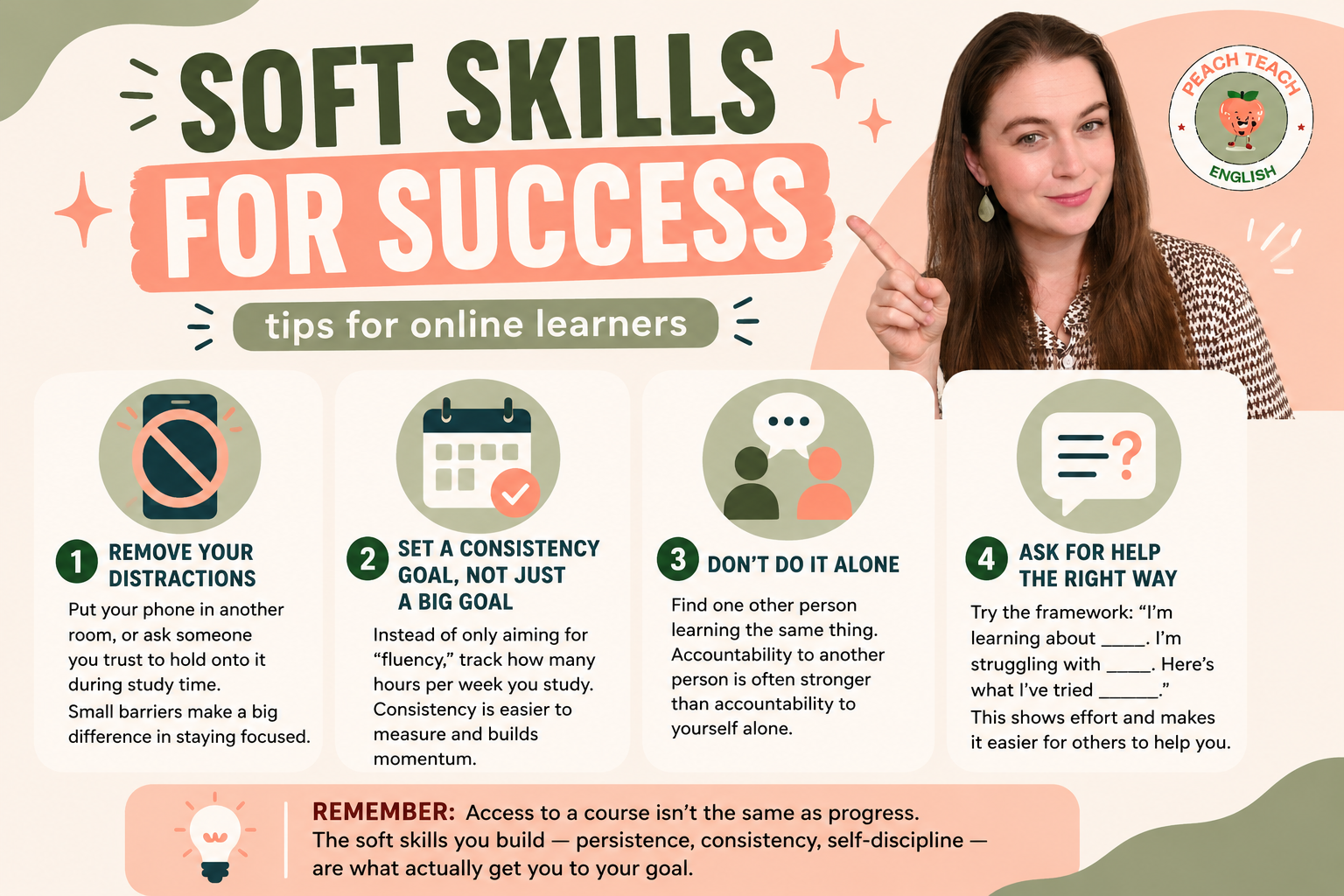
It's just very easy to take out your phone and glance up at your course and glance at your phone. So for me, there are a couple things that I do when I'm doing an online course on my computer, and I need to not be distracted by my phone. Usually, I put it in a separate room and either charge it or install one of those updates that I know that I can't use it.
If you live with another person or you're in a venue with a person you trust, you could give that person your phone for the duration of the time that you want to do the course. I find it valuable to just get my phone away, for sure.
I have another strategy, too, that helps measure how much I'm paying attention.
So let's say it's a course with a bunch of different videos. After each video, even if I'm by myself, I pause it, and out loud I just try to say in a few sentences what happened, what did I take away from this, what did I learn. And if I'm on my phone while I'm trying to watch that video, I can't do a good job in those few sentences, and I kind of embarrass myself.
But if I'm paying attention intently, it definitely helps cement that knowledge. But another benefit of saying those few sentences is that you can summarize that knowledge for later, and it helps you retain the knowledge as well. So those are some ways that I help to minimize distractions.
Frankie: It's a good way to make sure you're taking value away from that lesson and to stay focused.
We can have all these tabs open, receive notifications, have our phone next to us, so it can be really distracting, and it's important that we remove those distractions.
04:52 – What Are Soft Skills?
Frankie: And I would say this is a soft skill that we need. Self-discipline is probably one of the most important soft skills when we're talking about learning in general, but definitely online.
But before we hop into the soft skills that we need for learning online, this episode comes with a full transcript and study guide. If you'd like to access that, click the link in the description or scan this QR code here on the screen.
Eric, how would you define soft skills?
Eric: The definition that I like is it's basically the skill set of being able to communicate with and understand other people.
That is different from hard skills, which is more things you can learn and master, like math or technical skills or artistic skills, something like that. But soft skills tend to be more focused on interacting with people, understanding people, or understanding yourself.
Frankie: So some of them are gonna be more focused on working with others and your social skills, while others are gonna be more of those personal development skills, like persistence and self-discipline.
6:08 – Persistence & Accountability
Frankie: So whether it's learning English or computer science or whatever subject we want to learn, what do you think are some of the most important soft skills that we need to develop?
Eric: Persistence, because a lot of times you're doing an online course, you may hit a portion of the videos or material that you don't understand, and then it's sort of on you as the person taking the course to figure out, how do I go from not understanding this to understanding this?
You hope that the course will help you with that, but sometimes there are gaps that need to be filled outside of that. So persistence is so important because some online courses have forums where you can type questions, and those can be good, but also you may or may not get an answer in a timely fashion.
So persistence is about pursuing a lot of different methods to try to get the answers you need: a lot of approaches, like talking to people, looking at things online, maybe reading a book. But, but basically persistence is the ability to go through the struggles and to find the way that works best, even if some of the ways fail at first.
Something else we could talk about is that learning with other people can be valuable, too. Even if you're taking your own online course, if you find one other person or a group of people who are trying to learn something similar, that could be a great way to stay accountable and talk with people about your understandings and struggles.
Frankie: Yeah. The accountability, I think, is big for motivation, too. And I think that's where the self-discipline comes in. We're never motivated all the time every day. The self-discipline to still show up and push through i- is important.
But I really like your mentioning persistence here, because we wanna learn fast.
We want the answers quickly, and obviously with AI, the algorithms giving us these short videos all the time, we want these quick answers, and we also wanna be able to learn new things as fast as possible. But sometimes things are more complex. It's not something you can learn in the snap of your fingers.
You need to be able to have that persistence to keep going. And having people in your circle as accountability, they can even help you out if you have some questions. That's what we do as tutors as well, and I think that's another thing people can struggle with is motivation.
Eric: There are people that it's great to try to create your environment, to make it conducive to learning on your own. That's all well and good, but some people just have so much trouble sitting on their own, like doing something in front of their own computer and not getting distracted.
So the best way that I've found, and that a lot of my students have found to mitigate that, aside from working with someone like me, is to have a group of people learning about the same topic.
One of the beauties of the global world is that if you're trying to learn something, there's pretty much always someone else who is trying to learn the same thing, right? So finding maybe a group of those people and having like book clubs with them about the topic, and even if they're not taking exactly the same course as you, you can talk about what you've learned, talk about what your struggles are.
Mixing other people in can be so effective because it'd be really awkward if you missed a meeting with three other people, but if you just skip your time with the course. You're not really letting anybody down as much. And that brings up the idea that soft skills include the social aspect, the communication aspect.
Frankie: I love my one-on-one tutoring classes. I think they are very beneficial for students, but I think a lot of students underestimate the benefits of having small group classes as well. I think it can really boost that accountability and motivation.
Maybe you can see how another student did achieve something, and you can see that it is possible for me to improve and reach this level as well.
10:38 – Building Confidence & Asking for Help
Frankie: Specifically when it's learning a language, you realize, "Huh, that other person, they didn't speak perfectly, but they communicated their ideas. I understood. They got some corrections, so I can do that as well." And I think all of this helps build that confidence, which is another soft skill you need when learning.
And it's not necessarily, like, a confidence that is arrogant, where it's like, "I can do anything better than you." It's more of this belief in yourself.
Eric: Yeah. So I actually love that you mentioned confidence, because my opinion is that persistence and confidence are very tightly related to each other. For most things, if you are persistent and go through those difficult steps to learn, you become more confident at that thing.
I would venture to say that most people who are confident with a particular skill, or at talking, or whatever they're confident about, that there was some part of their life where they had to be persistent to get that skill. Confidence is just knowing that you can handle most situations. And that confidence is connected to the social skill.
Frankie: When we don't believe in ourselves, we're going to hesitate more in speaking up and asking for help. And I notice within my own classes, and can even be for myself sometimes, you don't want to ask people for help. But I think this is very important in online classes.
So Eric, why do you think students struggle asking for help?
Eric: Well, first of all, I used to struggle with this so much, and I still do sometimes. The major reason is asking for help is putting yourself in a vulnerable position. There's something that someone else knows how to do, but you don't, and you have to ask to get assistance with that, and that could be a very awkward feeling.
But also, in addition to that, I think a lot of people rightfully view asking for help as kind of a gamble in a way, 'cause you might ask somebody, and you may get a good answer, you may get no answer, you may get an answer, like, three weeks later. The gamble in combination with just generally making yourself vulnerable, that makes people kinda hesitant to do it.
But of course, as most people know who have actually gotten help, there are so many benefits. There are benefits to the person asking because you usually get help, but also for the people being asked, they like when people ask for their advice. They feel smart. They feel like they can benefit you.
So as long as you're respectful in how you ask, and I can talk about a way that I use to respectfully ask people for help, as long as you're curious and respectful, then people, more times than not, are very willing to help you.
Frankie: I wanna hear your suggestions, but I agree. We're generally either ashamed that we don't understand something, but I actually think that's coming from a lack of confidence. When we're confident in ourselves, we know that our lack of knowledge or understanding of something is not a reflection of who we are as people.
It's just something new that we don't understand yet, and if you believe in your ability to understand it, then I think you're less ashamed to ask for that support. And the other one is we feel like we're annoying the other person, but especially if someone is your tutor, your teacher, your coach, mentor, it's their job to help you.
So never feel ashamed about asking these people for support. In my classes, I always tell people when they ask me questions, "I love questions. Ask me more questions. Bring your questions. That was a great question." I really want to encourage them to ask more, because then we can actually solve the specific problems that they are struggling with.
So asking questions is actually one of the fastest ways to get the results you're looking for.
14:53 – How to Ask for Help Effectively
Frankie: But yeah, Eric, what are your strategies for doing this politely?
Eric: Yes, I give a little framework that I use. So whether you're typing a question or whether you're asking a person live, but I like to say,
"I'm learning about this thing."
So you tell the person what you wanna learn.
"So I'm learning about X, and I'm struggling with this thing."
So, like an example, I'm learning computer science, and I'm struggling with this programming language. And then after that, I just say,
"This is what I have tried in order to get past that struggle."
So ideally, when you're asking for help, there's something you will have tried.
You may or may not have tried the right thing, but at least people appreciate when you try to help yourself. But not only do they appreciate it, but it helps them help you, 'cause they might see something in what you're trying and say, "Oh, you're looking at it this way, but maybe you should try looking at it this way."
So basically the framework is
I'm learning about this, struggling with this, and this is what I've tried. Can you help me?
And then more times than not, people will respond to that.
Frankie: And I think to add to that, 'cause it's gonna depend on the situation and what you're asking for help with, I think it is useful to repeat back what you understood, and then specifically ask for the part you didn't understand.
For example, when learning a language, it could have just been you lost focus, you didn't really hear what they said. Maybe there was some new vocabulary. Maybe it was just something complex, and you're unsure.
So maybe you just need to say,
"Hey, can you repeat that again, please?"
"I didn't quite catch that. Could you say it again, please?"
You could also check your understanding.
"Let me see if I understood. So what you're saying is blah, blah, blah."
I would even say this can be the most beneficial because you're checking to see if you understood, and if we're able to repeat it back, then you know you understood it very well.
So I think those are all great methods to clarify and ask for help.
17:05 – The Importance of Staying Curious
Frankie: And I've noticed within my classes, let's say we read a paragraph and we stop and I ask, "Do you have any comprehension questions?" Any vocabulary questions? I'd love to be able to read their minds and know what they understand and what they don't, but if they do not communicate with me what they don't understand, that exercise could actually be a complete waste of time if they just pretend to understand things they don't.
And I have had situations where I ask, "Is there any new vocabulary?" And they're like, "No." And then I'm looking at it, and I'm like, "This is an advanced word. Let's see if they understand." And I ask, and they're like, "No, no, actually, I don't know what that is." And it's like, well, why didn't you ask? This is the opportunity to learn and understand these new words.
So I actually think it's good to approach learning not as a know-it-all, but to be humble and ask those deep questions. Really try to understand things as deeply as possible, because you might be missing some parts of it. That's another soft skill, being curious.
What do you think?
Eric: I totally agree, and in terms of encouraging people to ask for help, so something that helped me get more of my students to actually ask me questions was, it's great to say, "I'm open for you to asking me for help," and that sometimes works, but what actually helped the most is when I started saying, "When I did that in school, that was so hard."
But when they see me saying that I struggle with something, it kind of opens the door for them to ask their own question. They're like, "Oh, even the tutor one struggled with this, so I'm gonna tell him what I'm struggling with now."
But also, like you said, just diving deeper into questions. So if you ask, "Do you understand this?"
And they say, "Yes, I understand it."
Then you say, "Oh, what do you think of this?" Or, "Can you explain this part?"
And then if they don't understand it, there's some point that'll break down, right? So kinda diving in, and it's, like, part of our job as tutors to maybe expose that gap in understanding, too. So that's another interesting aspect of it.
Frankie: Which is a soft skill as a tutor, right? Being able to have the social skill to help students feel safe, like they can ask those questions, and maybe break down some of those walls that they've built up.
I think as a language tutor, it's a lot of them. People are perfectionists. They don't wanna make mistakes. They feel like they can barely make a sentence, and it's uncomfortable.
And creating that space where it's okay to struggle through this together. When you can let them know that you also struggled through this, it lets them know that they're not alone, which is also a big social soft skill that we can develop.
20:10 – Time Management & Consistency
Frankie: I think another one, and maybe we touched on it a little, but I want us to go deeper. When you're not showing up to a physical school, it can be easy to maybe not prioritize the class or the learning. You can reschedule it. Maybe you see it as optional.
And at the same time, when it comes to learning something, the time you spend in class is very important, but the time you dedicate to improving outside of class is also important.
And I think this requires a lot of time management and organization. Do you see students struggling with this?
Eric: Yeah, for sure. And I definitely have some things that have worked for some of my students to do better with issues like these. Let's say it's the kind of online course that you're purchasing and could put on the shelf.
What I would do is set a goal for how long you wanna do it, like per day or per week, and then actually put a slot in your calendar. Basically, if you wouldn't skip a meeting with another person, why would you skip a meeting with what could be your future self having learned this online course material?
And then the other thing is I have this special board called Trello where I make these cards so I could see visually, like what I need to do and what I haven't done yet. So I find a lot of benefits to those things.
Frankie: Have you had experience with any of those strategies?
Eric: So I haven't used Trello, but I know you speak very highly about it.
Frankie: Is it like an app or a platform?
Eric: It's like a website where you can have visual columns and a board. It helps you keep track of the progress you've made.
Frankie: And Eric, could you share the link with us?
Eric: Yeah, I could definitely share a link to that.
Frankie: I usually leave resources mentioned in the description, so you guys can check out that link if you wanna use Trello to help you with time management and productivity.
I don't use Trello, but what I find really helps in terms of time management, again back to that self-discipline: we are not perfect, so I think it's important to remember to give yourself grace. You don't have to get it right every day. But if one day you can't do it, it just means get right back on track the next day.
But I think having a plan is very important to be successful at online learning, and really knowing what goal you're trying to achieve. So a lot of my students would be like, "Okay, I wanna learn English. I wanna be fluent in English," things like that. And that's a good goal. But it's not really easy to measure.
And I actually think one of the best ways to measure your progress is consistency goals.
And if you're being consistent, you will have progress. And that actually helps you focus more on what you're doing and not looking at some big goal you have in the distance that's very far away. You can look at what you achieved today.
In my specific case, I'm helping students improve their English, right?
So to have this soft skill of time management is you need to think, "How many hours a week can I dedicate to this?" And knowing your goal is important, right? Because maybe you have a timeline, and so that's gonna help you create the plan you need for that timeline.
Dedicating about an hour, two hours a day is a good place to start if you're trying to be fluent in English.
But if you're someone who's very busy, even just 30 minutes a day starts to add up, and you can see that progress. But it's not just, "I'm gonna study." I think the more detailed you are about that plan, the easier it's gonna be to know what you're doing today.
So I often encourage students to practice reading, listening, writing, and speaking every week.
You can do one hour a week for each skill, two hours a week for each skill. But if you're doing that, you will see progress, and you could possibly even reach the next level in six to eight months if your study methods are really good.
So I think having a plan is important for that time management.
Eric: Yeah. And I think along the lines of consistency too, anything's better than zero, right?
So if you do 20 minutes instead of an hour, that's not quite the hour you wanted, but it's still better than nothing, and you shouldn't count it as, like, a failed day. Maybe you did a little less today. Maybe do a little more tomorrow, or work your way up.
But anything that's not zero is progress, right?
Frankie: Oh, for sure. Something is always better than nothing. I think that's another soft skill, knowing your energy level and your self-awareness to know when to maybe push yourself harder or to give yourself that grace and permission to relax.
Eric: Yeah. I totally agree, knowing your energy. Like for example, I know that naturally I have more energy, say, mid-morning than I naturally do after dinner time. I try to schedule my most important goals or courses for that mid-morning when I know that I will likely have that energy.
So that definitely is an important soft skill that can't be overstated.
26:05 – Soft Skills Beyond Online Learning
Frankie: Yeah. Totally. And Eric, how can these soft skills help students beyond online learning?
Eric: Yeah. So the two major areas that I think about all the time with these soft skills, one is interviewing for jobs. So kind of like we were talking about persistence earlier. I know that every time I go into an interview cycle, I fail so many interviews with so many different companies, and persistence comes in because it's about realizing that when you fail those interviews, like some people might stop and just not talk with any more companies if they run into that.
But it's about realizing that you're good enough. There could be a lot of reasons beyond your control that you didn't get hired for particular roles. So it's a skill that, with practice and by doing more interviews, that you can build that persistence.
And also a lot of people that I talk to, what most people have as dream jobs, they say, "Oh, I got into the company on my third try," or, "I talked with 10 other companies first."
I think most people don't just walk into interviewing and have it all mastered.
Also, just in the general workplace, being persistent is valuable when it comes to getting promotions, getting raises, but also figuring out problems at work.
Frankie: So when we're learning, we were talking about consistency, self-discipline, asking for help, all of these soft skills that we mentioned that are really important when we're learning something new.
But they're so valuable that we can take outside of the classroom, too. Professionally, you get that work ethic to be able to be persistent, to keep growing in your career, to keep working on something even though it's challenging and maybe you're not getting it right the first time.
And then it even goes outside of that, like in our personal life.
You might be trying to change some habits in your life, maybe something to make your health better. Maybe you want to be a good father or mother. And so all of these soft skills will help you be able to make those changes in your life to be successful.
And then maybe one of the most important is the social skill, right?
We're able to have better relationships with our relatives, with our friends. When we meet new people, we have the confidence and the social skills to be able to maintain small talk for hours.
And I think all of this is, especially the communication part, is so important for what I tutor, for these students learning English.
It's not just understanding the grammar, but it's also having the confidence to be able to try and keep that persistence, like you said, Eric, even when it's a little tough, 'cause you might not have the perfect words.
29:02 – Final Tips for Online Learning
Frankie: And so the final question I have for you, Eric, is do you have any final tips that you would like to leave with our audience today?
Eric: Yeah. So I think my biggest thing would be don't confuse access to online learning with progress. It can feel really good to buy the course, join the platform, get the tutor, but it's really about having all those skills that we've been talking about to see that through and get the real benefits of what you're trying to accomplish.
I'd say that's my main bit of advice, and set those goals to keep you on a good roadmap to success.
Frankie: Exactly. And I think that's a really good thing to end on here. Don't try to do it all. There are a lot of courses out there to help you learn English, to help you learn programming languages, and I'm sure a lot of them are great.
Do a little research, choose one, and stick with it.
29:59 – Connect with Eric
Frankie: Eric, thanks for joining us today. Could you let us know how we can contact you if we're interested in just getting to know you more or students are interested in working with you?
Eric: Sure. Probably the best place is my website, careercodepro.com, and on most social platforms my tag is careercodepro, all one word.
Thanks so much for having me today, and I really enjoyed the conversation.
Frankie: And Eric, how could you help these students?
Eric: So I specialize in math help and technology because I have a lot of experience in the domain of software. But I also offer general career mentorship. So I'm happy to do that for anybody who needs it.
30:42 – Closing Thoughts
Frankie: And there you have it, guys. If you want to succeed with learning English online, building your soft skills is a must.
Think about how you can develop your self-discipline, time management, focus, and communication confidence so you can get the English results you want.
Remember, this episode comes with a full transcript and study guide.
You can access it by clicking the link in the description or using this QR code here on the screen.
Thank you for listening to the Peach Teach English Podcast. I'm Frankie Mesmer, your host, and this space is dedicated to taking you from B1 English to B2 English fluency and beyond.
If you liked this episode, be sure to hit that like button, subscribe, and I'll see you in the next episode.
💼 Soft Skills Vocabulary Guide
The Peach Teach English Podcast — Soft Skills for Online Learning
The following vocabulary was used in this episode. These words and expressions are commonly used when talking about learning strategies, professional development, and workplace communication. They will help you build confidence discussing soft skills as you work toward B2 English fluency.
🧩 Types of Skills
Soft skills (noun) – Interpersonal abilities related to communicating with and understanding other people, such as persistence or self-discipline
Hard skills (noun) – Technical, teachable abilities that can be learned and mastered, such as math or coding
🌱 Personal Traits & Mindset
Persistence (noun) – The ability to keep trying and find a way forward, even when some approaches fail
Self-discipline (noun) – The ability to keep yourself on track and motivated, even without external pressure
Vulnerable (adj.) – Open to being judged or hurt, often because you're admitting you don't know something
Perfectionist (noun) – Someone who avoids mistakes and wants everything to be flawless, which can make speaking up harder
Humble (adj.) – Not being proud or arrogant
To be a know-it-all (phrase) – To act as though you already understand everything, instead of staying open to learning
⏳ Productivity & Self-Management
Consistency (noun) – Doing something regularly over time, which the episode calls one of the best ways to measure real progress
Time management (noun) – The ability to organize and plan how you divide your time between activities and priorities
Accountability (noun) – Being responsible to someone else for your actions — for example, a study partner who notices if you skip a session
Self-awareness (noun) – Understanding your own energy levels, emotions, and limits well enough to plan around them
To give yourself grace (phrase) – To be kind to yourself when you don't meet a goal, instead of treating it as failure
Roadmap (noun) – A plan that shows the steps needed to reach a goal
🗣️ Workplace & Professional Language
Work ethic (noun) – An attitude of commitment, effort, and reliability toward work or learning
Framework (noun) – A structured, repeatable way of approaching a task or problem — for example, a set method for asking for help
To mitigate (verb) – To reduce the severity or impact of a problem, such as a distraction or a difficulty
Conducive (to) (adj.) – Helpful in creating a favorable result, as in creating an environment conducive to learning
To cement (knowledge) (phrase) – To make information firmly fixed in your memory through practice or repetition
To underestimate (verb) – To fail to fully recognize the value or importance of something, such as small-group classes
✨ Quick Tips for Building Soft Skills
📚 Resources & Tools
🎙️Trello
🚀Join the Conversation Club
Join for just $99/month and get multiple weekly conversation practice sessions with frankie and other students to build the English-speaking confidence and fluency that you need.
Book a FREE consultation to learn more
📱 Connect with Eric
📱 Connect with Frankie
🍑 Peach Teach English Services
🚀 Want to Reach B2 English Faster?
This episode is part of my B1 to B2 English Fluency Series. Each episode helps you expand your vocabulary, improve comprehension, and speak with more confidence.
👉Check out the full FREE B2 Study Guide
🚀Upgrade to the B2 English Online Course
For just$5/month, you can get access to the B1 to B2 interactive course with reading, listening, speaking, and writing activities—designed to help you reach B2 English fluency faster.
Book a FREE consultation to learn more


