Life as an Immigrant | B2 English Listening
What is it REALLY Like to Move Abroad?
Welcome back to the Peach Teach English Podcast!
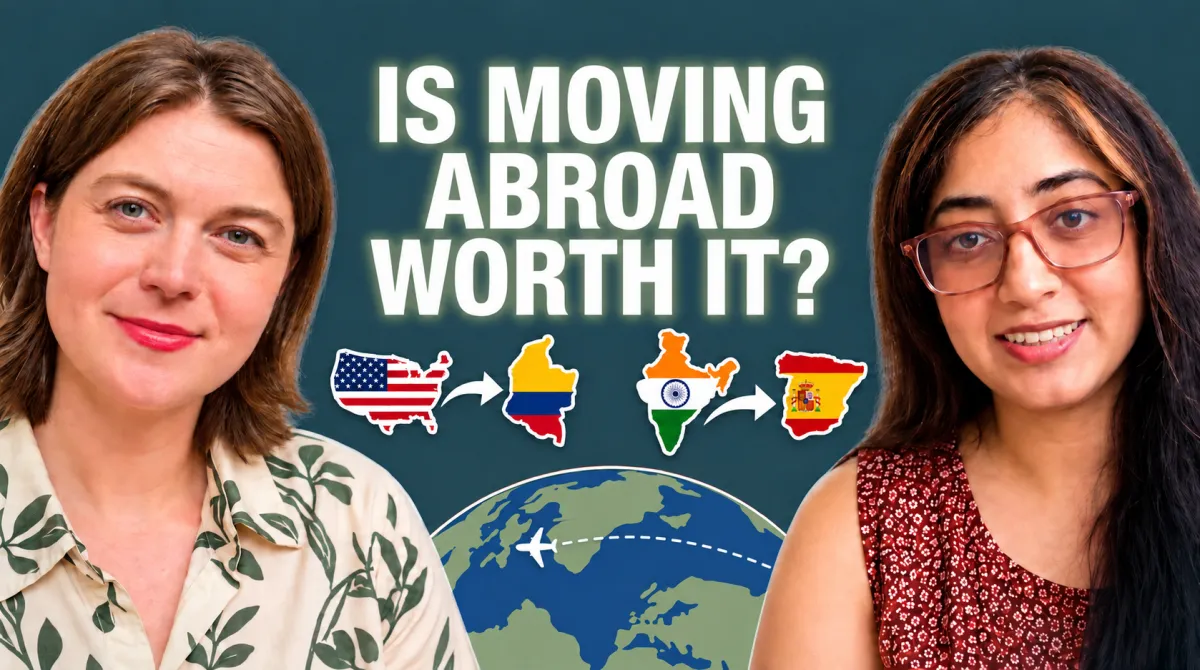
Moving abroad can be an exciting opportunity to experience another culture, learn a language, and build a new life. However, it also comes with challenges—from visas and unfamiliar customs to homesickness, culture shock, and finding your place in a new country.
In this episode, I interview Kirti, a journalist and communications professional who moved from India to Spain. We compare our experiences—hers in Spain and mine in Colombia—and discuss language barriers, cultural adaptation, identity, confidence, and the personal growth that can come from life as an immigrant. You’ll also hear natural English and expand your vocabulary related to immigration, culture, and living abroad through a real conversation in English.
Subscribe to Get Weekly Podcast Updates
Listen to the Peach Teach English Podcast
📝Episode 53 Transcript
00:00 – Intro: Dreaming of Moving Abroad
Frankie: Are you dreaming of moving to another country? For many people, learning English is the first step toward making that dream a reality. But while living abroad can be an incredible adventure, it also comes with challenges that many people don't expect.
In today's episode, I'm joined by Kirti. We'll share our immigration stories: hers from India to Spain and mine from the United States to Colombia.
00:28 – Moving to Spain: Kirti’s Story
Frankie: So, Kirti, thank you for joining me today. Could you introduce yourself and tell us what inspired you to move from India to Spain?
Kirti: Hi, Frankie. I'm very excited to be here and share my story. So, I started my career journey as a journalist and a communication professional. Few years down the line, I decided to learn Spanish so that I could find other opportunities in India.
While I was learning Spanish, I got an opportunity to teach English in Spain. So, I thought, maybe let's go to Spain for a year. Let's see, how is it? How is life there? And before that, I had never stepped outside India, so it was obviously an exciting opportunity. So, I got selected in Madrid. I came in 2021, and that's how I came to Spain.
Frankie: Okay, so you've been in Spain for five years.
Kirti: Yes.
01:20 – Moving to Colombia: Frankie’s Story
Frankie: Nice. I've been living in Colombia for almost nine years now. I moved here in 2017. Why did I choose Colombia? I fell in love with a Colombian. I wouldn't say that's the only reason I made the move, though.
When I was 18 years old, I traveled to Nicaragua, and I really loved my experience there, but I was very frustrated with the fact that I couldn't speak Spanish. I couldn't speak to the people. They still made me feel very loved either way, but when I got back to the States, I was like, “I really want to learn Spanish.”
So, I majored in Spanish at university, and I had always dreamt of moving abroad to a Spanish-speaking country—be able to use what I learned and have new experiences. But Colombia won because I fell in love with a Colombian, and I stayed. I like it here.
02:21 – Moving Abroad: How Kirti Prepared
Frankie: And Kirti, my next question is, how did you prepare for moving abroad to Spain?
Kirti: So, as I mentioned, it was my first time outside India, so I was very nervous. I used to get a lot of anxiety because there was a lot to prepare: paperwork, and physically, mentally also I prepared myself. If I'm stuck in a situation like this or that, what would I do?
So, yes, I did a lot of preparation around paperwork, what to carry from India to Spain, and how to navigate life once I land: money, documentation, being secure, finding a house. I had lived in different parts of India, but stepping out of India was a very different environment for me.
03:03 – Is a B1 Language Level Enough to Live Abroad?
Frankie: I'm curious, Kirti, did you feel like your Spanish was good enough to handle most situations?
Kirti: So, I was learning Spanish in India, and when I came to Spain, I was already B1 level, so I felt quite comfortable and confident, and I don't think I would have moved without Spanish.
Because in India, I have lived in Mumbai, and a lot of people speak Marathi there. I don't speak it, so it's very difficult when people are speaking, and you don't even understand a word. You can lose your independence quite a bit if you don't speak the local language well.
Frankie: So, are you saying, Kirti, you feel like when someone has a B1 level, they should be able to handle situations quite well?
Kirti: It gave me a lot of confidence at the airport or outside, or while house hunting or while visiting government offices for paperwork. That, yes, I can manage some basic conversation, but there were times that I used to struggle to understand their accents because Spain also has different accents. But with time and practice, I improved and all.
So, when you moved to Colombia, did you speak Spanish?
Frankie: Yeah, I actually majored in Spanish at university, so I had a formal education in Spanish. And yeah, I already spoke it quite well, probably somewhere between, like, a B1-B2 level. Probably B2. I was just shy about it. I didn't quite have the confidence to speak in all situations.
And I think moving abroad is something that helped me with that 'cause it's not just talking yourself up in some situations. It's like—I gotta do this every day. You face the different situations. You build relationships. I think at B1, you're in a good position to move abroad.
Of course, there's some gaps, but that might be one of the best things to help you fill those gaps because you recognize them. We can't really fill gaps that we don't see that need fixing.
05:09 – Visa Challenges When Moving Abroad
Frankie: You said that you had to get some paperwork ready. On the document side of things, what did you have to do to prepare for the move?
Kirti: In India, if you're traveling to EU, you have to get these police verifications. Your passports need to be, like, completely valid, and other paperwork. If you're traveling abroad, it's good to be safe than be sorry. I like to have more paperwork just to avoid stress, last-minute worries.
Frankie: So, you had to get a visa?
Kirti: Yeah, visa also. So, once I was accepted for this teaching program, so I received an acceptance letter, and with that letter, I could apply for visa.
Frankie: I feel that visa work is a little stressful. You want everything to go well.
Kirti: You don't want to miss out on the opportunity. So, you want to make things easier for yourself as well as the people at the consulate or the embassy. I like to have everything in order so that things go smoothly.
Frankie: How long did it take them to approve your visa?
Kirti: I think it takes around one to two months to approve your visa. You have an appointment, and then they tell you that once everything is done, they will inform you. If they are not satisfied with a certain document, they will contact you again, and also there's a cost involved. So many people are applying for visas, and it's easier to get rejected.
Frankie: You need to give it your full attention 'cause a little mistake can mean a rejection. I totally understand that. My situation wasn't so planned. I moved to Colombia in October of 2017, and I actually moved to Cartagena. I did not have a job lined up, so there definitely was some risk there.
I was like, “I'm going to move and look for a job.” I wouldn't necessarily encourage everyone to choose that path, but that is the path I chose. And I did get a few job offers in the first two months, but I chose not to work for those companies.
And after that, I realized that there were better jobs in Medellin, so I moved to Medellin. And then shortly after, I also found a pretty cool opportunity.
It was actually a volunteer program through the government. They paid us a stipend instead of a salary, and we went into the public schools to teach English, and that was my introduction to being an English teacher. Because I joined that program, that's when I was able to get my first visa that wasn't just a tourist visa, but it was called a visitor's visa.
And unfortunately, it was only for six months because the government cut the program I worked for, and so I was back to being on a tourist visa after that, and then it's like, what do I do now? Because, like you said, it's very important we stay updated on our documents, right? So, I had 90 days to find a solution.
I actually had a roommate from Ireland at the time, and he told me, “Oh yeah, I work part-time at this language school. I can talk to my boss and get you a job.” So, that's what he did. I worked there for a few years, and they helped me get a visa as well. But I can't even tell you how many visas I've had in nine years. Maybe six or seven different visas. I've had to keep them updated quite frequently.
What's your situation with that, Kirti, in Spain?
Kirti: So yeah, a couple of times I had to get my visas. That is always a part of being a foreigner in a new country.
09:09 – What We Love About Life in Spain and Colombia
Kirti: What is your favorite thing or aspect about Colombian culture?
Frankie: I think it's probably the warmness and friendliness of the people. They're very happy to help you, talk to you.
What's your favorite part about Spain?
Kirti: I really like that Spain is a very green country. There are forests you can go for hiking.
So, I was in Galicia for two years, so I used to live very close to the beach. And I think, for me, that has been a very beautiful part about living in Spain.
Frankie: I guess when you asked culture, I wasn't thinking so much about the nature, but the nature in Colombia is next level. One of the most biodiverse countries in the world. Most species of birds in the world. It's eternal spring, so it's green all year. It's one of the largest producers of flowers in the world, number two after the Netherlands. If you're a nature person, Colombia is a great place to be.
Kirti: Are there many foreigners in Colombia?
Frankie: It's definitely growing, the amount of people moving to Colombia. The number one group of immigrants in Colombia comes from Venezuela. And then after Venezuela, it's the US. We're the second-highest group coming here as immigrants, so I guess I'm not so strange.
Kirti: I think Spain has mostly Colombian, Venezuelans, then people from Morocco, and Americans are also here. I think it's a mixed population here.
Frankie: I feel Spain is rich in terms of people from different countries. Spain is very famous in the world. A lot of people want to visit there. I think it's a top destination for retired people as well. People love the food in Spain.
I really loved my experience in Madrid. I want to go back to Spain 'cause I only visited Madrid. I didn't get to see other areas, and I know Spain has a lot to offer, so I will definitely go back.
11:19 – The Challenges of Immigrant Life and Identity
Frankie: And so, Kirti, talking about immigration, we can glorify all the fun parts of it. But reality is living in a new country, a different language, a different culture—it comes with its challenges.
What has been the biggest challenge for you as an immigrant?
Kirti: So, yeah, I agree with you completely, Frankie, on this. It's been one of the most difficult decisions in my life. It's not easy to live in another country.
Since I come from India, there has been a lot of cultural adaptation also for me. Because in India, India and EU are very different in terms of culture, climate, food, people, habits, lifestyle, the social etiquette, work etiquette, everything. It's like, for me, it has been a rebirth or reinventing myself, my own identity, how I build friendships, relationships, how I hang out with people.
Because in India, I was a very big introvert. I used to hang out with a few people or just spend more time with family or doing my own thing. But here, I've been pushed out of my comfort zone. Every week, I try to socialize more.
I'm rediscovering myself every day. So, I'm not the same person who moved here five years ago, and I noticed that change within one year of living here or two years of living here. I go back to India, and I miss something. India is my native country, my family, friends, relatives—but still, I feel that something is missing. I'm missing Spain. So, even though it's a new place, I love being here.
Frankie: It's really fascinating, this concept, like you have two homes or you have no home.
I mean, you can kind of look at it the way you want or feel about it, but when you've lived abroad for a period of time, when you go back to your home country, it is home, but, like, it's not. You don't live there, and the reverse culture shock can be quite interesting. I arrive at the airport in the US, and I'm still speaking Spanish to people because that's what I do every day. And it's like I can speak my native language again. I don't have to keep speaking Spanish.
It's also interesting, though, like, when you are in the country where you've moved and you're an immigrant, it starts to feel more like home, but you also feel that it's not your native country.
There are some cultural things that are different, and I'm a big believer that it's not like one culture is superior or better. They're just different. And I also think every culture has their pros and cons. There can be some little quirks and things that they might not be your favorite part of the culture, but get used to it the best you can. You have to learn how to adapt to your new home.
The big one for me is, like, the punctuality thing. One time, I threw a Halloween party. The first people were, like, three hours late. Not a few minutes—three hours late. I started the party without them.
I wasn't waiting three hours for the party to start. I don't think that's every party situation. It's also not strange for that to happen here. In the US, this would be very rude, to show up to a place so late. And that's been one of the things that I have to be understanding of the local culture.
They're just cultural differences, and I'm not saying, like, one is better than the other. When your cultural habits are different, there can be a little bit of a confusion in the beginning, and just learning how to respect those differences when living abroad is very important.
15:04 – Adaptation vs. Assimilation
Frankie: I don't think you have to completely assimilate. I don't really like that concept, but I do think you have to adapt and be respectful of the local culture. What do you think, Kirti?
Kirti: So yeah, I feel that I'm trying to adapt. You are also trying to adapt. So, it's like Spanish culture and Indian culture have their own similarities. Like, both cultures focus a lot on family, fiestas, and food, but they're very different also.
So, I try to celebrate my festivals in my own way, or I sometimes dress up in my completely Indian attire. I listen to Indian music. Yeah, I try to keep a balance.
And yeah, if I'm outside, I try not to dress up in a traditional Indian attire. There are occasions where you decide, “Okay, here I'll wear a more Western dress,” or maybe, “Here there will be more Indians. I'll wear an Indian dress.”
Frankie: So yes, completely. I also feel that adaptation is much better than complete assimilation because you're carrying your culture, your roots along with you.
You're not leaving anything behind. Yes, you're mixing your culture with another culture, and I think I find that very beautiful. We don't need to all be the same, right? That multiculturalism is very beautiful. We need to be able to adapt in some ways and still be respectful.
But yeah, never abandon the parts of yourself and culture that you identify with.
16:32 – Personal Growth and Confidence Through Living Abroad
Frankie: As a final question, what do you think you've learned the most by being an immigrant to Spain?
Kirti: So, I would say, for me, it has been a journey of immense growth and learning and unlearning.
I've learned that you should always be open to change, adaptation, growth. I think that's a part of life, and when you're moving abroad, you also have to learn a lot of new things. Maybe reinvent yourself.
Personally, as I mentioned, I was a big introvert. Now, I try to socialize more. Not too much, but I try to strike a balance. So, I think, for me, living abroad—like, earlier, I used to be very homesick. My first two years, there was a lot of homesickness.
But now, I'm more comfortable. I'm trying to learn more skills. I'm trying to grow where I am currently. Do my best. Because it's also a choice that you want to be in this country. It's important to grow your roots where you are currently planted also.
So, that's what I'm trying to focus on. And apart from work, I try to give a lot of importance to my diet, my physical health. I work out a lot. My mental health, I read books. I like to cycle. I have a lot of hobbies also. For me, it has been a lot of personal growth, also moving outside India, because I think it's part of the process.
Frankie: Yeah, I agree. I think one of the biggest growth I've experienced is my confidence. I think I've always struggled a bit with being confident. But moving to a new place, I had to face that fear, get out of our comfort zones, and that's when growth can really happen.
I believe I became more confident because I gave up on perfectionism. I'm not gonna speak perfectly every time. I'm not gonna have this Colombian accent when I speak. I am Frankie Mesmer. I'm from the US. I speak Spanish. I speak it like this, and I'm definitely working on improving it as much as I can, but I'm not going to let the fear of making mistakes or imperfection keep me from living my daily life.
And that carries into other aspects of your life. When you go into work or build relationships, you start being more okay with not being perfect. Maybe that's just something I struggled with, but I think it was a big help to my confidence.
And not only that, but when you remove yourself from the culture you grew up in, and then you're surrounded by a new one, you really get more self-awareness, and you get to start asking yourself those deeper questions.
Am I this way because I was told to be this way, or am I this way because I truly identify with this culture, these qualities, and these elements? When you're surrounded by a lot of people with the same views, ideas, whatever, you kinda just continue going with the flow, and you don't really think about it.
And so, it's kind of nice to put yourself in a new place. You truly get to know yourself better. For example, like country music it's from my culture, and I love it even more because it reminds me of home. I feel a connection to it. Now, I still love my Spanish and Latin music and everything, but there is something special about that part of me, that connection that I have to my culture. And I think you really start to see the beauty of it when you have this experience of moving abroad.
20:15 – Advice for Moving Abroad: Is It Worth It?
Frankie: I want us to leave a great tip with the audience today. So, if someone is already living abroad or considering moving abroad, what piece of advice would you give to them?
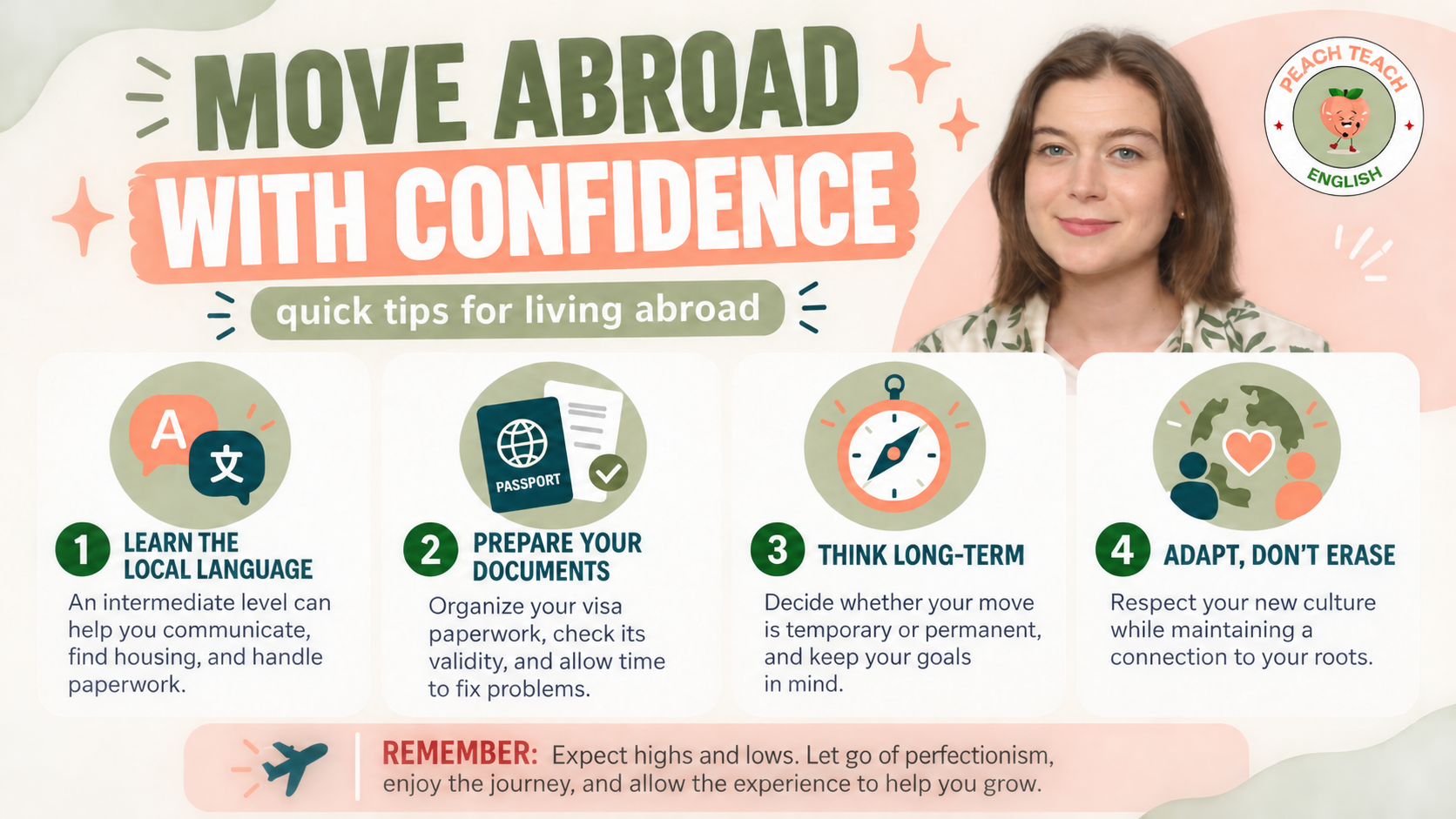
Kirti: Do it for your growth. Don't follow... This is not a trend of living abroad, moving abroad, because there is a lot of work that goes into it: before the move, during the move, after the move. It's not an easy process.
There's a lot of work that goes into it. We're constantly working on ourselves, our jobs, our personal growth, professional growth, clients, a lot of other things. So, I would say be prepared and just enjoy the journey. And there will be some highs and lows.
One thing also I feel is that one must also focus on the long-term goals. Don't follow just because everyone is doing it. It's not a trend. Look at your long-term goals, look at what are your choices, what are your situations, everything, and then make the best decision for yourself.
Frankie: Yeah, exactly. My advice is ask yourself this question: is it a temporary move abroad because you wanna push yourself, or are you looking more at a permanent situation? 'Cause you're gonna handle those differently, yeah?
But my biggest tip for you is I personally would advise everyone to at least live abroad once in your life.
Will it be challenging? Of course. But I think that the life lessons that you'll learn from the experience are worth it. And hey, if you don't like it, you can always move back home. But give it a chance and watch how much you'll grow from the experience. There will be challenges, but you will grow through it, and it will be a beautiful journey.
Yes. And just keep in mind, it doesn't matter what country you're immigrating to; there's bureaucracy, the visas can take a long time, it's complicated, so do what you have to. But hey, I've been in Colombia for nine years, and I became a resident this year. It took me nine years to become a resident in Colombia. It's a process, but trust the process, and it's totally worth it.
Kirti: Yeah, it's totally worth it, I would say.
22:38 – Wrap-Up and Where to Connect
Frankie: And well, Kirti, thank you so much for joining me today.
Would you like to share your contact information with the audience? I'll leave it in the description.
Kirti: Sure. If anybody wants to reach out to me, they can drop me a message on LinkedIn or Instagram, or my email.
Frankie: Thank you, Kirti, and thank you, everyone, for joining me today.
By the way, this episode comes with a full transcript and study guide, so if you'd like to check that out, you can click the link in the description or scan this QR code here on the screen.
And thank you for listening to the Peach Teach English Podcast. I'm Frankie Mesmer, your host, and this space is dedicated to taking B1 students to B2 English fluency and beyond. If you liked this episode, be sure to hit that like button, subscribe, and I'll see you in the next episode. Bye.
🌍 Life Abroad Vocabulary Guide
The Peach Teach English Podcast — Life as an Immigrant: Adapt, Grow & Belong
The following vocabulary was used in this episode. These words and expressions are commonly used when talking about immigration, cultural adaptation, and building a life in another country. They will help you discuss the challenges and rewards of living abroad as you work toward B2 English fluency.
✈️ Moving Abroad
To move abroad (phrase) – To leave your home country and begin living in another country
To have a job lined up (phrase) – To already have a job arranged and ready to begin
Paperwork (noun) – Official forms and documents that must be completed for a particular process
Documentation (noun) – The official papers needed to provide information or proof
House hunting (noun) – The process of searching for a house or apartment to rent or buy
To navigate (verb) – To find a way through a new, difficult, or unfamiliar situation
🛂 Visas and Immigration
Immigrant (noun) – A person who moves to another country to live there
Visa (noun) – An official document or authorization that allows someone to enter, remain in, or work in a country
Consulate (noun) – An official government office located in another country that assists citizens and processes documents such as visas
Embassy (noun) – The main official office representing one country’s government in another country
Stipend (noun) – A fixed amount of money paid regularly, often to someone participating in a program rather than working in a traditional salaried position
Bureaucracy (noun) – A system involving many official rules, documents, and administrative processes
Resident (noun) – A person who officially or legally lives in a particular country or place
🌎 Culture and Identity
Cultural adaptation (noun) – The process of adjusting to the customs, behaviors, and expectations of another culture
Reverse culture shock (noun) – The difficulty of readjusting to your home country after living abroad
To assimilate (verb) – To become fully absorbed into another culture, sometimes by giving up parts of your original cultural identity
Multiculturalism (noun) – The presence and acceptance of multiple cultures within the same society or community
Roots (noun) – A person’s cultural, familial, or geographical origins
To reinvent yourself (phrase) – To change your identity, habits, or way of living in a significant way
🌱 Challenges and Personal Growth
Homesickness (noun) – Sadness caused by being away from your home, family, or familiar surroundings
To step out of your comfort zone (phrase) – To do something unfamiliar or challenging that helps you grow
To strike a balance (phrase) – To find a healthy middle point between two different needs or priorities
Self-awareness (noun) – A clear understanding of your own personality, feelings, beliefs, and behavior
To go with the flow (phrase) – To accept a situation and continue without trying to control everything
✨ Quick Tips for Moving Abroad
📚 Resources & Tools
🚀Join English Classes with Frankie
Prepare for life abroad by practicing your English conversation every week with Frankie and other English learners.
Book a FREE consultation to learn more
📱 Connect with Kirti
📱 Connect with Frankie
🍑 Peach Teach English Services
🚀 Want to Reach B2 English Faster?
This episode is part of my B1 to B2 English Fluency Series. Each episode helps you expand your vocabulary, improve comprehension, and speak with more confidence.
👉Check out the full FREE B2 Study Guide
🚀Upgrade to the B2 English Online Course
For just$5/month, you can get access to the B1 to B2 interactive course with reading, listening, speaking, and writing activities—designed to help you reach B2 English fluency faster.
Book a FREE consultation to learn more


