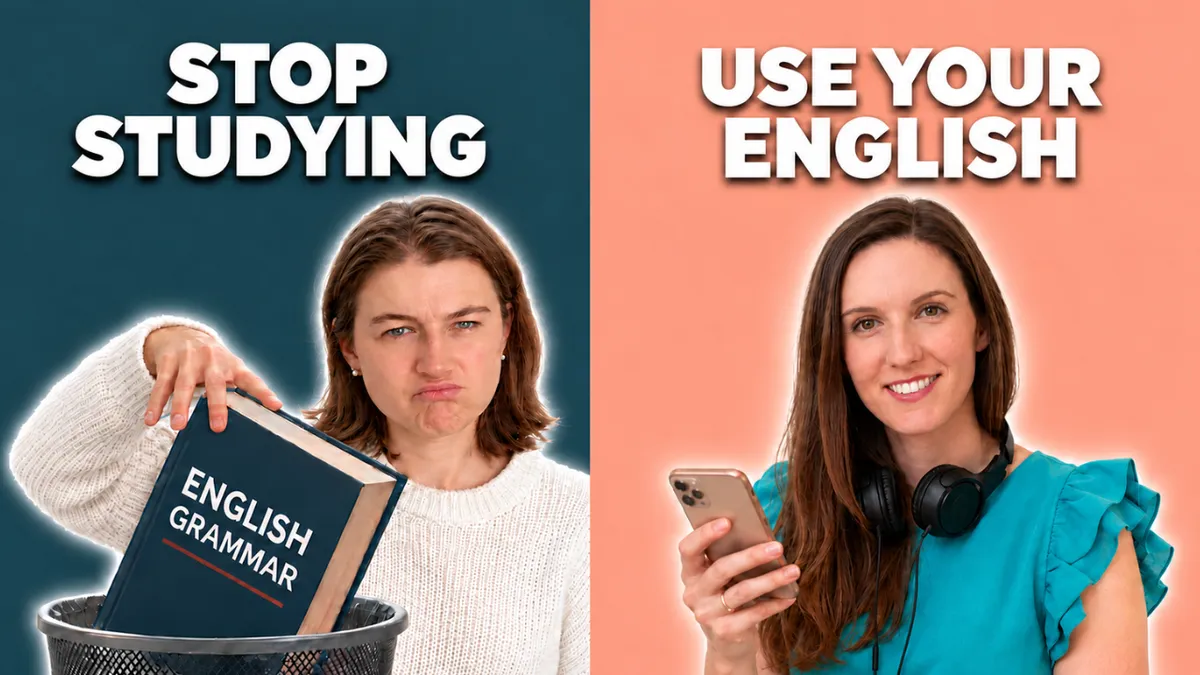
How to Use the English You Learn in Everyday Life
Make English Part of Your Life—Not Another Study Task
Welcome back to the Peach Teach English Podcast!
Finding time for English can be difficult when you’re balancing work, family, and other responsibilities. But practicing doesn’t always have to mean adding another study session to your schedule. Your hobbies, daily routines, and online conversations can all give you opportunities to use English and work toward greater fluency.
In this episode, I talk with Paja, an English teacher from the Czech Republic, about making English a natural part of your life. We share our language-learning experiences and explore practical ways to practice speaking, improve pronunciation, and apply the grammar and vocabulary you’ve learned. You’ll also get English listening practice through a real conversation about building confidence and using everyday English.
Subscribe to Get Weekly Podcast Updates
Listen to the Peach Teach English Podcast
📝Episode 54 Transcript
00:00 – Why You’re Not Fluent
Frankie: Have you been studying English for years and wondering why you're still not fluent? The problem might not be that you need to study more. You might need to start using English more. Today, I'm joined by Paja, an English teacher from the Czech Republic, to talk about how you can make English part of your everyday life, even if you're busy or don't live in an English-speaking country.
00:25 – Meet Paja: English Teacher from the Czech Republic
Frankie: So thanks for joining me today, Paja. Could you introduce yourself and tell us a little bit about your own English learning journey?
Paja: Hi, Frankie. First of all, thank you for having me. I'm Pavlina Boch. I'm from the Czech Republic in Europe, and I've been teaching English for over 11 years. I run multiple conversational clubs. I run a Let's Talk online club, and then I also run one in-person conversational club for moms and their kids.
And then I have my one-on-one clients. And my main goal is to help my clients to stop learning English and actually start using it by making it part of their life.
01:05 – Paja’s Story: Why Memorizing Wasn’t Enough
Paja: My English learning story played a big role in the way I teach now because it used to be very bumpy.
It wasn't a really easy one, and it wasn't always straightforward. I went through the process of always second-guessing every word I said, always doubting my English, being worried of speaking, and I even failed a speaking exam at the university. And at that time, I knew something had to change, and so I decided to accept the opportunity to go study to Michigan in the United States.
And that played a big role, and that helped me a lot to actually realize that the way I had been learning English, the conventional way, wasn't really working out for me. Because I was memorizing all the grammar rules. I wasn't really understanding them. I was just memorizing them, and I was memorizing or trying to memorize vocabulary lists, but that never worked for me because I don't think I'm a smart person for learning languages, I would say, and I'm also a lazy one, kinda.
So this never worked for me because I didn't have any relationship to the vocabulary list. I didn't have any connection. I'm unable to learn vocabulary lists. That's not how I learn. I really need to experience the language, and that's what I'm trying to pass on to my clients, this way of learning.
Because everybody's super busy nowadays. My clients don't really have time to sit down and learn and memorize and drill. This is what I'm trying to help them with, trying to show them other ways how they can acquire the language rather than learn it.
Frankie: And I think it's so important to hear your story, Paja, because the listeners can see that you were in the same place as them.
You didn't grow up fluent in English like me. But listen to you now. You speak so well. You're on a podcast. And now you're teaching people, and through your experience, you have a lot of insight that maybe I can't personally share as a native speaker.
03:20 – Frankie’s Story: Studying and Using Spanish
Frankie: Now, I have studied other languages: Spanish, Portuguese, French, and Turkish. I'm not fluent in all of them, but I do love studying languages. I also don't think I have a natural talent for languages.
I think it is different, though, because I enjoy studying languages. And I think there could be a switch where I went a little bit from studying to using, but I think pretty early on I started out using the language because my main inspiration for learning Spanish, which was the first foreign language I studied, was because I went to Nicaragua, and I hated that I couldn't speak and understand people.
So when I went back to the States, I said, "I don't know what I wanna do with my life, but I want to learn Spanish." And so I started making that my life goal. And every day I texted the people I met in Nicaragua. I was literally at zero and just trying to communicate the best I can. But then I enrolled in Spanish classes at university as well. So I was studying and using it at the same time, and I really think that's why I was able to learn it quite well and quickly. I usually had the best grades in my class, but I don't think it's because I was better.
I think it's 'cause I was immersing myself in the culture as much as possible.
04:51 – Understanding Real English
Frankie: And so that's my next question for you. How did you go from studying all the grammar rules, memorizing vocabulary lists, to actually using the language?
Paja: Well, knowing the language and being actually able to use it are completely different things, because I had been studying English very hard for many years prior to coming to the United States. And then, you are immersed in that environment, and you are trying to speak with the native speakers, and all of a sudden I didn't understand them. I met my husband, my boyfriend back then, and I didn't understand him.
And back then, at the university and prior to that, I had been really trying to practice listening. But all those listening that I had been doing were not the natural listenings. It wasn't authentic language. It wasn't the language that people actually use. So it was a language from textbooks.
And then you go to the United States, and people are, "Hey, what's up? How are you doing?" And you're like, "What? We say, 'How are you?'"
And then I also realized that way more important than perfect grammar is pronunciation and understanding. So that's what I also focus my lessons on, because that played a big role for me, when I went to a restaurant and I wanted to order water, and I used British English. The lady was like, "What?" And what else could I be possibly asking for? But even from the context, she didn't deduce what I could've been possibly asking for.
And so that made me realize that you can have perfect grammar, but the pronunciation is way more important than the grammar. Because even if your grammar is not accurate, people still can deduce what you are trying to say.
Frankie: So that's really interesting, and I agree that focusing on pronunciation, and not just your own pronunciation, but also the way the native speakers are pronouncing, because that's directly connected to your comprehension.
So, focusing on how you pronounce and how others are pronouncing, I think in a quick time you'll actually start to see your understanding of the language and people understanding you quite quickly when you focus on that.
07:18 - Creating Your English Bubble
Frankie: And so my next question is, when we say, “Stop studying the language and start using it,” what do we mean by that?
Paja: So for me, what I'm trying to explain to my clients telling them that they need to really immerse themselves in the language and create their English bubble in the Czech Republic. And that doesn't mean that they need to marry an American like I did or move abroad, but just little steps. Switch your phone into English, and when you switch your phone into English, all the apps immediately change, too.
When I go online grocery shopping, all the groceries are in English. All the products and everything is in English. So you're really exposed to the English on a daily basis. And read books, watch series.
But I also recommend, when they are reading books, read it out loud. So it's not just passive learning, but also active. Or even better, listen to an audiobook with that and shadow it. Shadowing. I love shadowing. When you are listening to podcasts, Spotify has a great function where you can see the subtitles, and they are interactive, too, so you can replay just individual sequences, and you can shadow them again.
Or what I do when I'm driving: I shadow everything when I'm listening to podcasts. I would shadow you even when I was listening to your podcast.
Frankie: Ooh, nice.
Paja: Everything you can do it in English. Do what you like, do it in English. Are you doing yoga? Do yoga in English.
Watch videos of yoga in English. Or if you like journaling, I've heard journaling is great. I've never tried that, but I have a student who has tried that, and it worked great. One of my clients, all of a sudden, her level has improved a lot, and it's like, “Okay, what's, what's happening? What's going on? What have you started doing that there's such improvement?”
“So you know, Paja, I started recording myself when I'm driving in the car. So I record, like, mini vlogs, and I use English when I'm driving, and I'm talking about my day.”
She doesn't publish it anywhere, but I could immediately notice the progress and the improvement. Or I have a client; she talks to her horse in English.
So even this active production and use of the language, even if you are talking to a horse. I had a student who was talking to a toy bunny at home. Just really try to use it. Everything has to come out of your mouth, because speaking is so hard. Speaking the language is really hard because there is that constant fight in your brain where you have to push back your native language and push forward the new language that you are learning, and then you need to speed up these processes.
This constant fight needs to become faster until it is not a fight anymore.
It's like trying to ride a bike and only learning about it from textbooks, and not actually having any hands-on experience. So first, yeah, you can read about pedaling, you can read about balancing, but if you don't practice it actively, you will not be able to ride the bike. And then when you really practice, you ride a bike, then you end up doing wheelies.
The more you speak, the faster the fight in your brain will become. And also, when you are speaking, your mouth needs to get used to articulating differently. So it's all about creating these habits where you are speaking and your brain and your mouth get used to it, and it becomes natural for you.
Frankie: I agree, Paja. I think that also helps your own psychology get used to hearing yourself speaking another language. 'Cause I think that's maybe part of why we're uncomfortable. It's like, “I sound a little weird or unnatural. This is uncomfortable for me. The ideas come to my mind slowly.”
And of course, anything you're starting to do for the first time, it's challenging. But the more you do it, the more natural it becomes. And actually, with my own experience in language learning, I've gotten to where I can think in Spanish without telling myself to do it.
It just happens. And I think that's the ultimate goal. I've sat down to watch a movie by myself, and generally my TV is in Spanish, and I'll watch the first 10 minutes and then realize, “Hey, I'm watching this movie by myself. I can put it in English. I don't have to watch this in Spanish.” And the original's in English, so I would prefer to watch it in English. But you get to that point where it isn't as much work for your brain to process and produce the language. But we have to start somewhere, right? And memorizing all the rules and the vocabulary isn't really what's gonna get you to the next step.
13:39 - Do You Still Need to Study Grammar and Vocabulary?
Frankie: And I don't think that means stop studying the grammar or learning new vocabulary. Pay attention to the grammar and the vocabulary, but it shouldn't be the heart of your studies. The vocabulary and the grammar are tools to be able to help you communicate more correctly or effectively.
But you gotta take it the next step and apply it. And so I agree: listen to the podcast, to the song, watch the movie or series, read articles and books. All of that is like the receptive skills when we're bringing it in. And I think there are passive and active ways to study with receptive skills. And if you're only stopping at bringing it in, and you're not taking the next step to apply it in your conversations. You can also apply it with shadowing, taking the notes, and reviewing them. And then, like you said, journaling, maybe make your own examples, all of these things.
You have to start using it if you really wanna add it to your long-term memory.
So what do you think, Paja? Where does grammar and vocabulary lists have a place in learning a language?
Paja: That's a good point. I just wanted to get to that, actually, because I believe they do have a place in the learning process.
And I should add a disclaimer that immersive learning is great, but I don't think it necessarily works for beginners. Because, as you said, you learned Spanish, but you were also immersed in the language, and that's why you were making such great improvement and you learned Spanish fast.
When you are a beginner, you really have to put the effort in it. You need to work a little on it. You need to memorize some vocabulary like days of the week, months, whatever. And my husband is a great example how immersive learning does not work on beginners. He has been fully immersed in Czech language for over eight years, but he is still not able to speak.
He understands a little bit. He's able to talk a little bit, use some words, but this immersive learning on its own is not gonna get him to this intermediate level. At first, you need to put some work into it. You need to attend classes, let's say, or really learn, and while being immersed, but only immersion is not gonna do the trick, unfortunately.
Frankie: Yeah, for sure. He's your case study. Is he actively learning the language?
Paja: No, that's why it's not working. The immersion on its own, it's not working. Because he's only passively, like, listening, hearing it, reading it, but not really paying attention to it, not really actively learning, so it's not working.
I once even had a client who came to me for lessons, and at the same time, while he was having lessons with me, he was in the United States attending a course. He went to the United States with the goal to learn English in the environment.
He thought that fully exposing himself to the environment would do the trick, that it would be easy. But then later on he figured out, "Yeah, I have no idea what they are talking about. I have no idea what they want from me. I don't understand any of the assignments, any of the homework." So then he hired a Czech teacher to help him with the homework while he was in the States attending, which I'm sure a super expensive course.
You need to put some work into it because the immersive learning is not gonna work on its own at first. But once you hit that intermediate plateau, that's the time when you should really immerse yourself in English, because that can skyrocket you to another level if you do the right steps.
Frankie: Yeah, I really think combining them together is really what's gonna get you those big results. When you're listening to the podcast, there is benefit from just listening, but I think the exercise is even better if you're taking notes, you're identifying: what pronunciation was different than I expected, what new words or expressions did I learn from this, actually checking your comprehension, and all of this. I actually taught a lesson yesterday, used to versus would, to a B1-B2 student, and she told me, "I've never even heard of this before."
So it's something that you might not even realize exists in the language. And so there is a time to study grammar and see how it's used. I just don't think that should be the main focus.
17:25 - Using English in Your Daily Routine and Interests
Frankie: We're talking about: get out there. Have real conversations with people. Talk to yourself to train your brain to think in the language. Journal about your day so you can practice writing. Do you have any other suggestions?
Paja: Let me check my list. You can set your maps into English, so when you're driving, you're listening to the directions in English. When you are taking notes. I love note-taking, so I take the notes in English. When I'm writing into my calendar, I write everything in English.
Or when you are googling or using ChatGPT. Why don't you use ChatGPT only in English? I have one client who actually does that. When she's googling anything or using ChatGPT, she talks to ChatGPT solely in English. Then, when you are scrolling on social media, procrastinating, you can turn it into something more productive by trying to find only that English-speaking content, and then you can take it to another level by reading the comments or even comment yourself.
I highly recommend to all my clients: read the comments because that's where you see the real English. That's you see how people actually speak. And there you can see the mistakes they make, too. Their English is not perfect either. I highly recommend joining English-speaking Facebook groups about topics that you're genuinely interested in. I'm interested in bees, so I'm learning about bees through English because I'm in multiple beekeeping groups.
And so just anything like that. It doesn't feel like you are doing something extra, so it feels like a natural part of your day, not something that you need to add more hours to. Because my clients don't have time for that. I don't know about yours, but my clients really don't want to do the extra work for that.
Some of the clients who do, they make great improvements, and they are really way better. But the clients who don't have time, the progress is slower, way slower than for those who actually do something for English outside of our lessons.
Frankie: I love how you mentioned about social media. And any good content creator, guys, is told to have an engagement question. So whatever video you're watching, they're probably wanting you to engage with that video, and one of the best ways to do that is by leaving a comment. And therefore, you're taking the passive consumption and turning it into using the language actively. I love the idea of reading the comments, too.
Sometimes that's the best part. And also the creator's really thankful for that, because it helps boost their visibility, interaction with their content. So it's a way of also saying thank you to the creator for creating something to help you with your English.
So I think that's definitely a big help. And I actually have a follower on Instagram. She never misses a comment. And her English is amazing. She really has a great vocabulary. She's improving because every day she's getting in those comments on different videos and using the language. So that's a really easy and free way to start using it. Another one you said: the Facebook groups. I love that.
You can join things like book clubs. I actually have a book club. We'll start a new book in October.
We're gonna read Fluent Forever. It's how to learn a language and never forget it. That'll be a fun one. If you guys are wanting to become fluent in English, I imagine that's a good book to read and another way to use English. There's also some apps. Discord is popular. You can find a lot of cool communities there on Discord where you can connect with people. Instead of studying just the rules of English, you're actually interacting with native speakers and using it.
Paja: And choose topics you like because if it's not satisfying and fun, you're probably gonna give up. It needs to be something that is long-term sustainable. One student once came to me, "Hey, Paja, I've decided that starting tomorrow I'm gonna learn English for one hour every morning."
I'm like, "Okay, I admire the dedication, but do you think that you are able to stick with it?" And she was like, "Well, yeah, I think I could." Of course she didn't, yeah, because life happens. And then life takes a completely different course, and you need to adapt to it. So if you're doing something that doesn't feel forced, that feels natural, then it's long-term sustainable, and you are able to stick with it.
Frankie: Totally. And for me, that was more like podcasts when studying languages. I usually liked to find podcasts with a written transcript. Because I made it a listening and reading activity. Not necessarily at the same time. One day I listen, and then the next day I read, and then I look for all the new words, things I missed.
And then I listen again another day. And I also think this repetition is helpful for remembering. If you just listen one time, tomorrow we might forget almost everything. I don't think that's the only way, right? The key is to find: are you someone that likes podcasts, videos, movies, series, interviews, reality TV? I actually often really like, for learning, interviews, reality TV, not because they're better content, but I do think they're a little more natural.
Paja: I just started watching one, and I was like, "Okay, I need to recommend that to my clients." Yeah, we need to watch that together. It's Million Dollar Secret. There are just two seasons. It's on Netflix. It's not the love stories and so on, like Love Island or Love Is Blind. But yeah, it seems interesting.
Frankie: I watched a British one. I think it was called I Kissed A Girl. And I learned British slang that I didn't know.
Language is also more than the grammar rules and the vocabulary lists. It's the culture around it as well. When you start using it or consuming it in more natural environments, you actually get to see the way the language is used in real life.
23:56 - Don’t Let English Stand Between You and Your Goals
Frankie: Pavlina, if you wanted to leave one tip with our audience today that they could apply in their English study routine, what would it be?
Paja: I would say just take little steps. You don't need to do all these things that we have mentioned. You don't need to tomorrow implement all of them. But one by one, little by little, it's gonna go a long way. What I also tell my clients is, "Don't let English stand between you and your goals."
I have many clients who came to me like, "Yeah, I need to study English because I want to get this job, but I'm too scared to apply for it because there is an interview in English." You are professional at what you do. You are great at the field that you work in, so why would you let English stand between it? So accept challenges, don't be scared, and don't let English stop you.
Frankie: I love that. You're actually putting that obstacle there yourself, that fear. And you might actually surprise yourself how good your English really is and what you can accomplish. Even if it is super challenging, the only way to really get there is to experience it. Go try it. Go do it.
I also think you have to be honest when it is hard, when you don't understand. Tell the person, "I didn't catch that. Can you say it again?" Carry a little notebook in your pocket.
Write down the stuff you didn't get. Ask your friends, your teacher, "My coworker said this, I didn't understand it. Can you explain it to me?" Or literally ask them. I'm actually a certified medical interpreter from English to Spanish. And I shadowed some interpreters that were probably close to retiring, and they told me, "Frankie, we still write new words down every day."
And they are fluent; they're interpreters, 'cause you're gonna come across things you don't know sometimes. We're always learning. So I think the key is: be curious. When you don't understand, ask the questions.
But don't let English be an obstacle because you can do it.
26:11 - Connect with Paja
Frankie: Paja, could you let our audience know how they can contact you if they're interested in lessons?
Paja: You can find me on Instagram @pajaenglish.cz. That's P-A-J-A, english.cz.
The same website, pajaenglish.cz, or at LinkedIn, Pavlina Boch, B-O-C-H.
Thank you for giving me this opportunity to also step out of my comfort zone. As I tell my clients, you need to step out of your comfort zone. Only that way you will overcome the stress of speaking.
Frankie: It's true. I need to do a podcast in Spanish or Portuguese just to challenge—
Paja: Yeah.
Frankie: —myself, and maybe encourage my students as well. I think it's a great thing that you've done today, Paja. And you did great. As you can see, Paja's a great teacher. I really love her methodology, pushing her students to use the language and become more fluent.
So be sure to follow her on social media.
27:09 - Study Guide and Wrap-Up
Frankie: By the way, this episode comes with a full transcript and study guide, so if you'd like to check that out, you can click the link in the description or scan this QR code here on the screen.
And thanks for listening to the Peach Teach English podcast. I'm Frankie Mesmer, your host, and this space is dedicated to taking B1 English learners to B2 English fluency and beyond.
If you liked this episode, be sure to hit that like button, subscribe, and I'll see you in the next episode.
Bye.
🛠️ Simple Ways to Use English Every Day
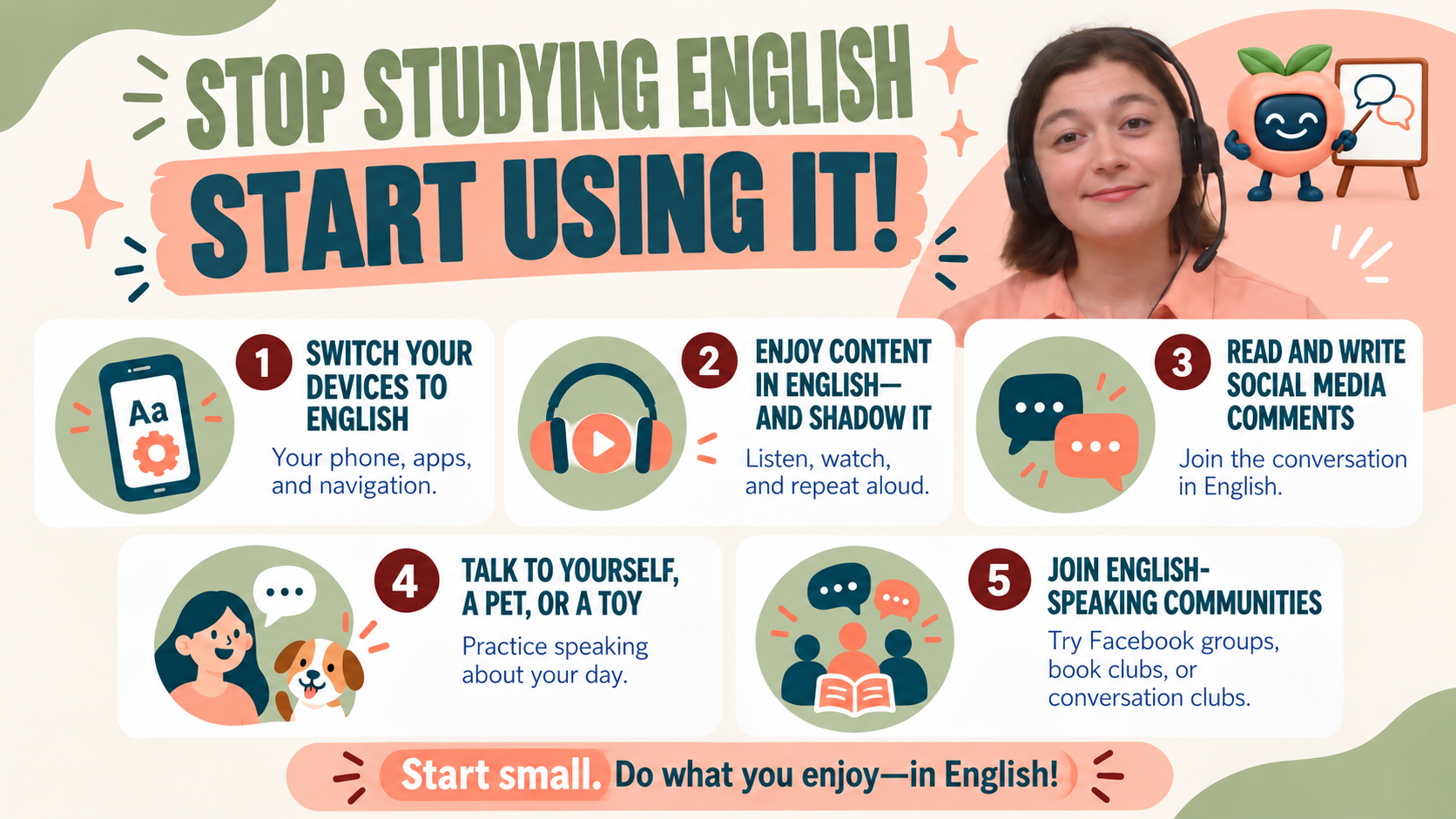
Make English part of the things you already do. Here are the tools and strategies we discuss in this episode:
📱 Daily Routines
Set your phone and navigation app to English.
Write notes and calendar entries in English.
Search online and use ChatGPT in English.
🎧 Listening and Watching
Enjoy podcasts, songs, movies, series, reality TV shows, and interviews in English.
Follow videos about your interests, such as yoga.
📖 Reading
Read books and articles about topics you enjoy.
Use podcast transcripts to check your understanding.
Read social media comments to see everyday English.
✍️ Writing
Journal about your day in English.
Text friends and leave comments on English-speaking content.
Write your own examples using new vocabulary and grammar.
🗣️ Speaking
Shadow: repeat short sections of audio, copying the pronunciation and rhythm.
Read aloud, including alongside an audiobook.
Talk to yourself, your pet, or even a toy in English.
Record yourself talking about your day.
Have real conversations and ask questions when you don’t understand.
💬 Communities and Clubs
Join English-speaking Facebook groups about your interests.
Find Discord communities where you can connect with others.
Participate in book clubs and conversation clubs.
🌱 Make It Last
Combine grammar and vocabulary study with opportunities to use them.
Take notes, review them, and apply what you learn.
Choose activities you enjoy and can maintain.
Start small—you don’t need to try everything at once.
Choose one thing you already do in your native language, and try to start doing it in English!
📚 Resources & Tools
📱 Connect with Paja
📱 Connect with Frankie
🍑 Peach Teach English Services
🎬 What to Watch Next
If you've ever felt like you can understand almost everything you hear in English but still struggle when it's time to speak, you're not alone. Check out this video where I break down exactly why that happens and what you can do to fix it.


