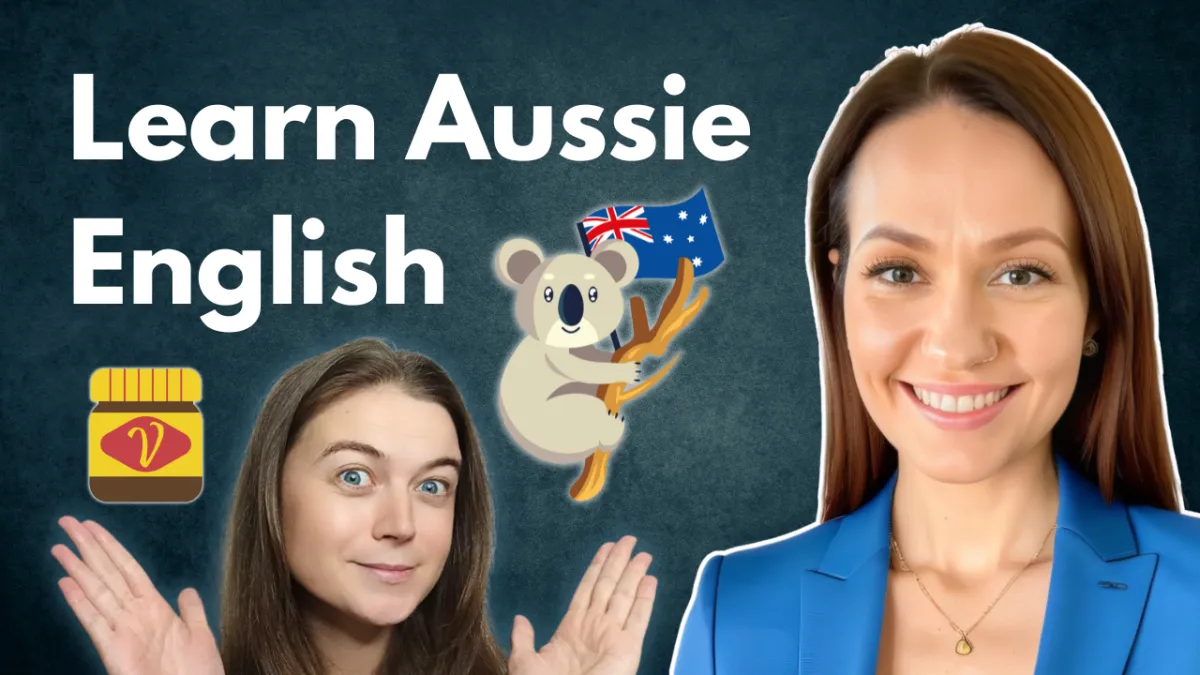
Learn Aussie English & Culture | English Listening Practice
Practice Real Australian English with a Native Speaker
Welcome back to another episode of the Peach Teach English Podcast! In this episode, I’m joined by Amanda from Aussie English with Amanda as we explore what it’s really like to understand and speak Australian English — from slang and accents to wildlife, food, and everyday life in Australia.
Whether you're planning to live, study, or travel in Australia, this episode will help you feel more confident in communicating with Australians and understanding how the culture influences the way people speak.
This episode + transcript is ideal for intermediate and advanced English learners who want to practice listening comprehension, learn authentic vocabulary, and develop cultural awareness that makes conversations smoother and more natural.
Watch & Listen to the Peach Teach English Podcast:
📝 Episode 33 Transcript:
00:00 Introduction and Guest Introduction
Welcome back to the Peach Teach English podcast. I'm Frankie Mesmer, your host, and today I have my guest, Amanda from Australia.
Thank you so much for having me here, Frankie. I'm Amanda. I am the owner of Aussie English with Amanda. You can't really see my logo 'cause the light's on, but basically, I am an English teacher, and I'm focused on the Australian English dialect. I help professional migrants and international students in Australia understand the accent, slang, and integrate into Australian culture.
Thank you so much for joining us today. I invited you because I want my audience to learn more about Australian English and culture, and I think you will be a great option for that.
00:42 Top Tips for Newcomers to Australia
And so my first question for you is: if someone were to walk off an airplane today and enter Australia, what would be the top three tips that you would give them?
Wear sunscreen would probably be number one. Stepping off a plane, Australia's UV rays—like the UV index—is so high in Australia. It's one of the highest. So sunscreen is non-negotiable. Really, really important to be wearing sunscreen. So that's probably number one.
Manners in Australia can be seen as a little bit different. I guess the expectation of politeness is different country to country. But in Australia, what is expected is that you say “please,” “thank you,” “excuse me.” I know it might be common sense to some people, but in some languages, those are built into the sentence structure in a different way. So when you translate from your language into English, it might not be a direct translation for you to be saying “please,” “thank you,” “excuse me.” So that's really important. You might accidentally insult someone without meaning to if you forget those things.
We use a lot of slang — not everyone, but definitely a lot of informal language, a lot of shortening of words, and a lot of slang. So just be mindful of that. If you do come across someone who says something that you don't really understand, it is okay to ask. Say, “Sorry, I don't understand what that means. Could you please explain?” Don't be afraid to ask someone what they mean. People will be happy to explain.
And I think even as native speakers, you could use some Aussie slang that I have no idea what it means. And as a native speaker, I would never be ashamed or embarrassed to say, “I don't understand.”
But I do think sometimes when it's not your native language, you feel a little embarrassed when you don't understand. And just remember — that's completely normal. The key is to understand, so ask that question and clarify.
Exactly. Maybe before you go, try to study some of that Aussie slang so that you aren't as lost when you get there.
Great tips. Yeah, absolutely. Wear that sunscreen, make sure you're being polite, have good manners, and study some Aussie slang before you get there.
Great tips. Yes, exactly.
03:15 Understanding Australian Regions and Slang
So, another question I have, Amanda, is I feel like I don't really know a lot of the regional geography of Australia. So, how would you break down the different regions of Australia?
80% of Australia's population live along the coast. So Australia is an island continent. It's the only island continent. If you think of the shape or the outline of Australia, it's a huge country. It has a lot of land mass, and 80% of the population live along some kind of coastline.
So the different regions, according to the government, have been kind of separated by, like—I can't remember the exact term—but it's like really “regionals,” which would be like in the middle of the country. Like, I used to live in the desert, right in the heart of Australia, and that would be extremely regional.
You've also got some cities that, you know—like the Gold Coast—that's a really popular city, but for visa purposes, that's known as a regional area. So there are different subcategories of regional Australia.
I grew up in a very small town on the coast — 5,000 people — and that would be known as a regional area. And we grew up using slang and informal language that people in, let's say, Brisbane might not even understand. I've taught slang on my Instagram, and I've had Australians say, “We don't say that.” I'm like, “Yeah, but I did. I do.”
And do you remember what the slang was, Amanda?
Yes. It's "petty." It was just the other week, actually. Petty — or I use a T-flap, so I say "petty" — P-E-T-T-Y — which is short for petrol. Like gas, you know, what you put in the car. And, you know, if I was carpooling with someone, I'd say, “I'll give you petty money. I'll give you petrol money.”
So that's one. And I've had this specific reel go viral on Facebook, and I've had so many people say, “What the hell is petty?”
I've started to put disclaimers when I know that there's a word that maybe is a bit more regional. I'll say, “This is what I grew up saying. Just because you might not have heard it doesn’t mean that it's wrong.”
Exactly. Petty.
Now, in Australia, do you also use petty as the adjective? Like, “That's so petty.”
Yeah, we do.
05:50 Must-Visit Travel Destinations in Australia
What would you say are the top travel destinations to visit in Australia?
Great Barrier Reef — absolutely. A lot of people don't realize the Great Barrier Reef doesn't start in far north Queensland. It starts in Bundaberg, which is about three hours north of Brisbane. So you don't have to go all the way to far north Queensland to get a look at the Great Barrier Reef. It is beautiful to go up there, though.
Uluru, which is in the heart of Australia, where I used to live, that is a big, big, big rock. It is a sacred structure that is sacred to the local Indigenous people, the local Anangu people. You used to be able to climb it, but then in 2016 — so it's been almost 10 years — they stopped allowing that because it is considered sacred in the local culture.
Indigenous people believe in spirits rather than, say, a god. So they don't have a temple or a church that they go to — they have places. So, people climbing that was considered disrespectful. It would be like us climbing a church or something. It's still a beautiful place to go, and they've really done a lot of work over the years to teach people — teach tourists — more about the local Indigenous culture, which is really, really great.
Sydney, of course — Harbour Bridge, Sydney Opera House — definitely the main ones.
I'm a big fan of nature tourism. Are there any other natural places you'd really recommend?
Oh yes — Darwin, Northern Territories. I used to live in Darwin, and they have beautiful national parks there with massive waterfalls and swimming holes. You have to be careful because crocodiles can sometimes be there. But yes — Kakadu National Park or Litchfield National Park, just around Darwin. Huge ones.
Also, you'll find that if you go inland from most capital cities, you'll find a lot of areas to go hiking, mountains to climb, waterfalls that you can swim in. I used to live in Brisbane, and not even an hour away — in between Brisbane and Gold Coast — you kind of go inland here, and there'd be waterfalls that you can go swimming in.
Wow. That sounds like where I'd want to go. What was the name again?
Twin Falls. I think it was called Twin Falls. That area — that's the name of that waterfall, but I can't remember the national park. Most of these places are in national parks, which are protected as well.
08:25 Exotic Australian Wildlife
You mentioned crocodiles.
So there are definitely some exotic animals to the rest of the world in Australia. What are some of those exotic animals, and how common is it to actually see them?
Crocodiles — you'll only find in the northern parts of Australia. And I've seen a few. They're just part of nature — they're part of the water.
Snakes, you've got. Spiders, you've got. A lot of different marsupials — koalas, possums.
Possums look like rats, but they're bigger. They make a horrible noise at night, but they're a marsupial. To those who don't know, a marsupial is a type of animal that carries their baby in a little pouch at the front — like kangaroos do. So kangaroo is a marsupial. Koala is a marsupial. And so are possums.
Oh gosh, there are so many. The echidna — it's kind of like your porcupine. It's got the spikes on the back. The platypus, which is a water animal. I've never seen a platypus before, but I've seen an echidna.
What I was going to say before: it depends on where you live. My hometown has 5,000 people. That town was in a kind of bush regional area, and that's where my dad still lives.
Just last year, when I was back home, I saw a blue-tongued lizard. I saw kangaroos. He has this frill-necked lizard that visits his house, and it sticks out the little frills on the side. My dad has found a snake before in his house, so yeah — it depends on the area.
I used to work at a rooftop bar near the river, and one day an alligator just came out of the river onto River Street in downtown. You could see down the street — people going crazy — and it was like, “What’s going on?” And it was an alligator.
In Australia, do you have sharks?
Actually, yes. Just a few. God, it must have been last year or the year before — there was a shark attack at one of my hometown beaches, and someone died. There are a few shark attacks a year that you see in the news — the news I follow, anyway — and I'm sure there are definitely more around the country that I don't hear about.
Yeah, and generally, shark attacks are pretty rare.
12:07 – Australian Cuisine and Unique Foods
And, as I was mentioning alligators a little bit, we actually fry them up kind of like chicken nuggets — the tail — and eat what we call gator tail. Do you eat crocodile in Australia?
I have, yeah. When I lived in Darwin, I have. I did. I mean, I'm vegetarian now, but yes, I did eat crocodile in Darwin. There's a crocodile farm there. Unfortunately, that's what they use to get the crocodile skin for crocodile leather. And then the meat — they sell there for people to buy.
I've tried kangaroo tail. So that's a thing. Not in big cities, but I mean — again, I lived in the Northern Territory. Darwin is known as the Florida of Australia — the kind of stuff people do in the Northern Territory. So yes, I tried all of these things when I lived in the Northern Territory, and it was just very much a normal thing. But I've never tried crocodile tail, though I have tried kangaroo tail.
Kangaroo tail. I've actually had kangaroo. There was this exotic meat butchery shop in Florida, and someone prepared kangaroo.
See? Florida. Yes — kangaroo meatballs. And I got to try that.
So what are some other common Aussie foods and drinks?
Most of the food that's popular in Australia, I swear, comes from other countries. Chicken parmigiana — we call it the chicken "parmi" in New South Wales, or "parma" in Victoria. Chicken parmigiana is Italian.
Chicken schnitzel — which I think schnitzel is German — we call it the chicken "schnitty." They're really popular at the pub.
Meat pies — I think I've read a few articles where Americans are horrified because pies are usually sweet in America. But we have savory pies that you can get at the petrol station or the servo. You just buy a little pie in the warmer there.
As for sweets, we have Anzac biscuits — or Anzac "bikkies" — which are basically rolled oats, coconut, and I think golden syrup. They're called Anzac biscuits because ANZAC stands for Australia and New Zealand Army Corps. During World War I, when the women were at home and the men were all fighting in the war, they were baking these biscuits. And because the ingredients were so simple, they didn't expire, so they could go on ships to the soldiers on the front lines. They lasted, and so they were called Anzac bikkies because the soldiers of World War I were known as ANZACs.
They're still really popular.
The Pavlova dessert — that's something we've claimed in Australia as our own, but New Zealand also says it started there. You can't really find online where it started — maybe both. So you’ve got the Pavlova.
Lamington — that’s a little sponge cake with chocolate on the outside and coated in coconut.
Oh, Vegemite — of course. I’m like, I’m missing something! Yes — Vegemite.
So this is a salty spread. A big mistake people make is thinking it tastes like chocolate or that it's sweet. So they put it on their bread or toast like that — thick. But you have to start off really small.
It’s salty. It tastes like soy sauce, basically.
I've actually had Vegemite. I need to try it again. I didn’t love it the first time around.
It’s an acquired taste. But it’s most commonly eaten with a piece of bread or toast — with butter first. So make sure you use butter, and then a little bit of Vegemite so it melts into the butter.
I personally like it with avocado and then cheese — and then have it as a toasted cheese sandwich or grilled cheese. Or you can have it open, and then you put it under the grill like this.
Okay, I need to try it with the butter and then see.
Yes, and put extra butter and just a little bit of Vegemite to start off with — because it’s really hard to take it off if you add too much.
And what do you think would be the American equivalent to Vegemite?
I don’t know that you’d have an equivalent. I wouldn’t say there’s one at all. But maybe something similar, probably just because it’s so representative of American culture. I would say peanut butter, just in the sense that we eat it a lot.
You have peanut butter and jelly a lot there, don’t you?
That’s a thing, right? Peanut butter and jelly is a classic. It’s not my favorite — it doesn’t match for my taste.
I prefer butter and jelly, and I like peanut butter and honey.
Okay, you can get crazy and make a peanut butter, honey, banana sandwich.
Oh yeah, that would be nice — I love peanut butter and banana on toast or on a sandwich.
Yeah, I could add a bit of honey to that. And I think Elvis Presley loved that snack.
Oh really?
If I’m not mistaken, he might’ve even thrown some bacon on there. And I think that’s just crazy.
Ooh, okay.
Yeah.
16:12 Social Etiquette and Small Talk in Australia
And do you have any other tips or challenges that you think people — let’s say immigrants moving to Australia — might face? Or students?
A mistake that I see people make is not really engaging with small talk. People ask you how you're going, but they don't always really care — it's just, you know, a formality or politeness. So make sure you ask the question back.
Let’s say you are being served at the café, and the café attendant says to you,
"Hey, how are you going?"
And you just say,
"Good, thanks,"
But you don't ask the question back.
You are going to look rude — but you're not meaning to, because you answered them. So make sure you ask those questions back, because that's part of the politeness we talked about before and shows good manners.
I just did a post this week on how to end a conversation politely. When you're ready to finish the conversation, say things like:
"Alright, well I better let you get back to it."
That’s kind of like saying, Sorry for interrupting what you were doing. I’ll let you continue.
You could also say:
"I’ll catch you later," or
"Have a good one."
Other options:
"Alright, well I better be off," or
"I have to head off now,"
which means I have to go. And then follow with "Have a good day."
Those are all really good, because you want to politely be able to walk away.
Sometimes, even with Spanish here — like I’m at the gym, and someone’s talking to me — I kind of want to continue my workout. I don’t want to keep chatting. And sometimes I feel like I do leave a little abruptly. I need to be able to kindly walk away.
So giving those expressions definitely will help people.
17:59 Recommended Media for Learning Australian English
So you said one of your tips was to make sure you expose yourself to Aussie English pronunciation before you go. What media would you recommend that people consume so they get that exposure?
It's hard because a lot of the shows I normally recommend — I don’t know how readily available they are outside of Australia. One show that I recommend to literally everyone is called Utopia. In America, the name got changed to — I think — Dreamland, because there were too many things called Utopia. So they called it Dreamland, I think it was.
Basically, it’s kind of considered Australia’s version of The Office. It gives a perfect insight into Australian workplace culture — accent, informal language, slang, small talking, sarcasm, and humor. It’s really great for all of those things.
Also, if you are just beginning to get into the language and you don’t mind watching cartoons, watch Bluey. You’ll find Bluey everywhere. It’s all over YouTube, and I think it’s available in most countries. It’s a little cartoon that uses Australian English vocabulary.
Frankie — they use the word thongs in Bluey. They use those kinds of words, plus phrasal verbs. For example, they’ll say things like “get up,” which means to stand up — simple phrasal verbs that might not be easily translatable if you try to translate each part in your own language.
So Bluey, definitely. And Utopia — if you can.
I watched — what was it — Heartbreak?
Heartbreak High.
Yes, Heartbreak High. That one was fun.
There’s actually a YouTube channel from the production company that makes Utopia. It’s called Working Dog Productions, I think. And they share snippets of Utopia — little three- or four-minute clips. So if you can’t watch the whole show, you can search Working Dog Productions or Working Dog Promotions. Just use keywords.
Use keyword search. Let’s say you love watching travel vlogs — search:
"Travel Vlogger Australia" or "Australian travel vlogger."
I have a student — she was really into crocheting — so she googled crocheting Australia, and she was watching videos on YouTube. So play around with some of those keywords, especially on YouTube, because you’ll be able to find something that piques your interest. That way, you’re more likely to stay connected while watching it.
And yeah, that way you’re getting a little bit of that exposure — even if you can’t find the other shows that I recommended.
20:42 Key Pronunciation Tips for Australian English
Is there any advice you'd like to give about Australian pronunciation?
The main rule — this is honestly the main rule you need to remember:
The only time we say R in Australian English is if the next sound is a vowel sound.
We don't go by writing. If the next sound is a vowel sound, we have to say the R. If it's a consonant sound, we don't say it.
This also works with linking as well.
Let’s think about the word “water” — or “water” (pronounced the Aussie way). It ends in R, so we don’t say it:
"wa-tuh."
But if the next word starts with a vowel sound, we’re going to link.
For example:
Water or Coke?
→ Water-or... Raw.
See how I'm making the R sound in “water or Coke”?
So in Australian English — and it’s the same in British, New Zealand, and South African English too — we don’t say R unless the next sound is a vowel sound.
So yes, that’s the main thing to keep in mind when it comes to pronunciation.
21:48 Conclusion and Farewell
And guys, Amanda really gives a lot of tips about Australian pronunciation, so I'd really recommend following her YouTube channel or Instagram — you can get a lot of tips there.
Yeah, it's Aussie English with Amanda — and I highly recommend it. Her content is really, really good.
So guys, thank you so much for joining us today, and see you next time.
Bye.
Thank you.
Thanks, guys.
Real Australian English Study Guide
NOTE: Australia has a lot of regional slang and pronunciation, so don’t worry if you hear something unfamiliar — it’s normal!
🧴 Top Tips for Visiting or Living in Australia
Wear sunscreen — UV rays are super strong in Australia.
Mind your manners — Always say please, thank you, excuse me.
Learn Aussie slang — People often shorten words or use unique phrases.
Don’t be afraid to ask for clarification — It’s okay to say: "Sorry, what does that mean?"
🌏 Must-Visit Destinations in Australia
Great Barrier Reef — Starts near Bundaberg, not just far north Queensland.
Uluru (Ayers Rock) — Sacred Indigenous site in the heart of the country.
Sydney — Harbour Bridge, Opera House, and classic big city energy.
Darwin (Northern Territory) — National parks, waterfalls, and wildlife.
Twin Falls — Waterfall destination near Brisbane/Gold Coast.
🦘 Aussie Animals You Might See
Crocodiles — Only in the north. Be careful when swimming!
Snakes & spiders — Yes, but mostly avoidable.
Marsupials — Kangaroos, koalas, possums, and echidnas.
Exotic animals — Echidnas, Blue-tongued lizards, platypuses
🍽️ Classic Aussie Foods & Drinks
Meat pies 🥧 — Found everywhere, even gas stations.
Vegemite — Salty, not sweet! Try it thinly spread with butter.
Chicken parmi / schnitty — Pub favorites (Italian/German inspired).
Lamingtons — Sponge cake with chocolate and coconut.
Anzac biscuits (bikkies) — Oat + coconut cookies with a WWI history.
Kangaroo / Crocodile — Exotic meats found in the Northern Territory.
📺 Aussie Media Recommendations
Want to keep improving your Aussie English skills? Start with these:
Utopia (Dreamland in the US) – A satirical workplace comedy that teaches Australian office culture, slang, and sarcasm.
Heartbreak High – A high school drama with modern Aussie slang and diverse accents.
Bluey – An animated show using real Australian vocabulary and expressions (perfect for learning phrasal verbs and daily phrases).
Working Dog Productions – Clips from Utopia
Use keyword searches related to your interests.
Example: “AustralianTravel Blogger", "Australian Crocheting"
You’re more likely to stay motivated when the content matches your personal interests.
🗣️ Key Pronunciation Tip: The Aussie “R” Rule
In Australian English, “R” is only pronounced when the next word begins with a vowel sound.
🧠 Example:
Water or Coke? → sounds like "watah-r-or Coke"
Water bottle → sounds like "watah bottle" (no R sound)
This rule also applies in British, Kiwi, and South African English.
💬 Reflection Questions
Practice your writing or speaking skills by answering these:
What’s one thing you learned about Australian culture that surprised you?
Would you be open to trying Vegemite? Why or why not?
What’s one new slang word or phrase you remember from the episode?
Which of the places mentioned would you love to visit?
What English shows or videos do you currently enjoy watching? Could you try one in Australian English?
🎯 Want to Practice English with Me?
Join our community and speak English with real people in weekly classes! Book your free consultation now:
👉 http://peachteachenglish.com/free-consultation
💖 Support the Podcast
Love this episode? Support the Peach Teach English Podcast for just $5/month and unlock bonus content & behind-the-scenes access:
👉 http://peachteachenglish.substack.com/subscribe
Find Amanda Online:
Website: aussieenglishwithamanda.com
Instagram: @aussie.english.with.amanda
LinkedIn: Amanda Boyce
YouTube: @aussie.english.with.amanda
Want to Learn More Aussie English?
👇 Explore the resources below to keep building your Aussie English confidence
📘 Amanda’s Mini Slang Guide: Download here
🦘 American vs Aussie English Vocabulary Blog: Read it Here
🎧 Play the Aussie Slang Game & Learn 7 Slang Expressions: Watch & Play Here


